La Victoire de Samothrace, largest sculpture in the Louvre!
Since 1884, visitors to the Louvre have been able to view at the top of the main staircase an imposing sculpture measuring 2.75 metres, or 5.12 metres when the full monument is measured: it is the largest sculpture on display in the museum. The depicted figure, missing its head...
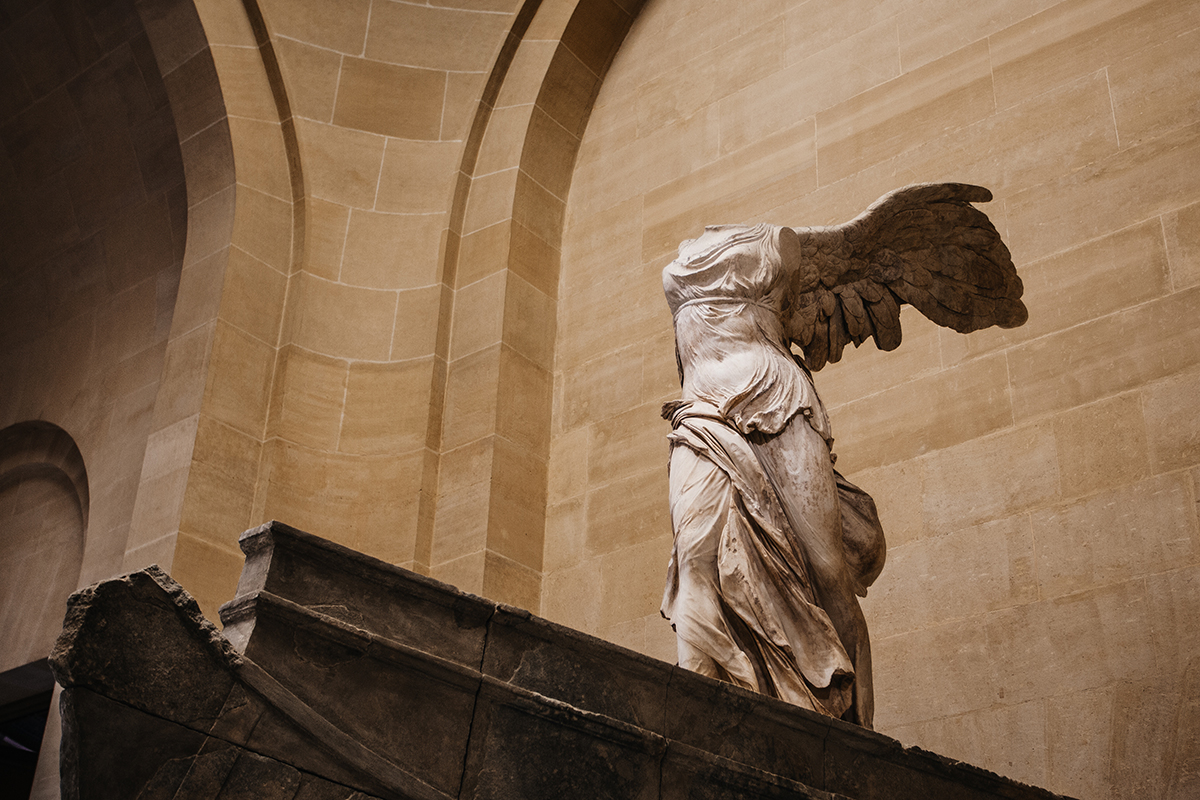
Since 1884, visitors to the Louvre have been able to view at the top of the main staircase an imposing sculpture measuring 2.75 metres, or 5.12 metres when the full monument is measured: it is the largest sculpture on display in the museum. The depicted figure, missing its head and arms, is the Victory of Samothrace discovered by Charles Champoiseau in April 1863 on the island of Samothrace.
“Stone muslin” was how Champoiseau described it to Napoleon III when informing him of his discovery. The sculpture, of exceptional finesse, conveys a sense of extraordinary ardour and vitality. With its base representing the prow of a ship, it is a genuine antique masterpiece, evoking for the observer a majesty imbued with power inviting one to delve into its history. So let us delve in!
The representation of a winged goddess
The goddess Nike – translated as Victory – was traditionally represented in Antiquity as a winged woman. She is here sculpted in white Parian marble, and dressed in a long tunic of delicate fabric, with a fold tucked under the chest and fastened to the shoulders by two straps. The lower part of the body is covered by a cloak leaving the left leg exposed.
The numerous drapery effects and the position of the cloak, partly falling to the ground and short at the back, suggest a desire to represent the wind – or the goddess’s movement. And for good reason: the right foot barely placed on the ground and her left leg still in the air and extended, betray that the goddess Nike is alighting just now on the prow of the ship on which she is represented. She is not walking, but rather has just finished her flight. The arms have therefore disappeared, however the raised right shoulder reveals that the right arm must have been extended or raised to the side. As for the left arm, no clue allows us to imagine its position.
The meaning of the whole certainly corresponds to thanksgiving addressed to the Great Gods following a naval victory. The right arm could address a salute to the crowd, while the left could possibly hold a trophy of naval victory from that time: a stylis, a kind of mast from the enemy ship.
The base, in white-veined grey marble, comes from the quarries of Lartos, in Rhodes. Shaped like a long, slender warship equipped with a ram, it is covered with the representation of a fighting deck on which the statue stands. On the sides are visible rowing boxes and two tiers of rowing benches.
A complex identification
The precise context of the creation of the Victory of Samothrace is difficult to determine: in the 2nd and 3rd centuries BCE, naval battles were numerous in this region of the world. The Macedonians and the Syrio-Egyptians thus faced the Egyptians and then the Rhodians, for domination of the Aegean Sea.
If the dating remains uncertain, a clue is potentially left for us on a tetradrachm of the Macedonian general Demetrius Poliorcetes: the monument represented could well be that of Samothrace. From this, one can imagine that the battle concerned is that of Cypriot Salamis, at the end of which the Egyptian King Ptolemy I was defeated in 306 BCE.
For the German archaeologist Otto Benndorf, the Victory of Samothrace would date from the very end of the 4th century BCE and would have been sculpted by a pupil of Scopas. This is only a hypothesis that leaves many specialists skeptical, no work of this magnitude having been found elsewhere. On the other hand, all agree on finding a resemblance between the Victory of Samothrace and the altar of Pergamon preserved in Dublin, notably in the manner of sculpting the bas-reliefs. Our sculpture offering no visible signature apart from a summary fragment, the mystery remains unresolved.
An emblematic cult site of the Greek world
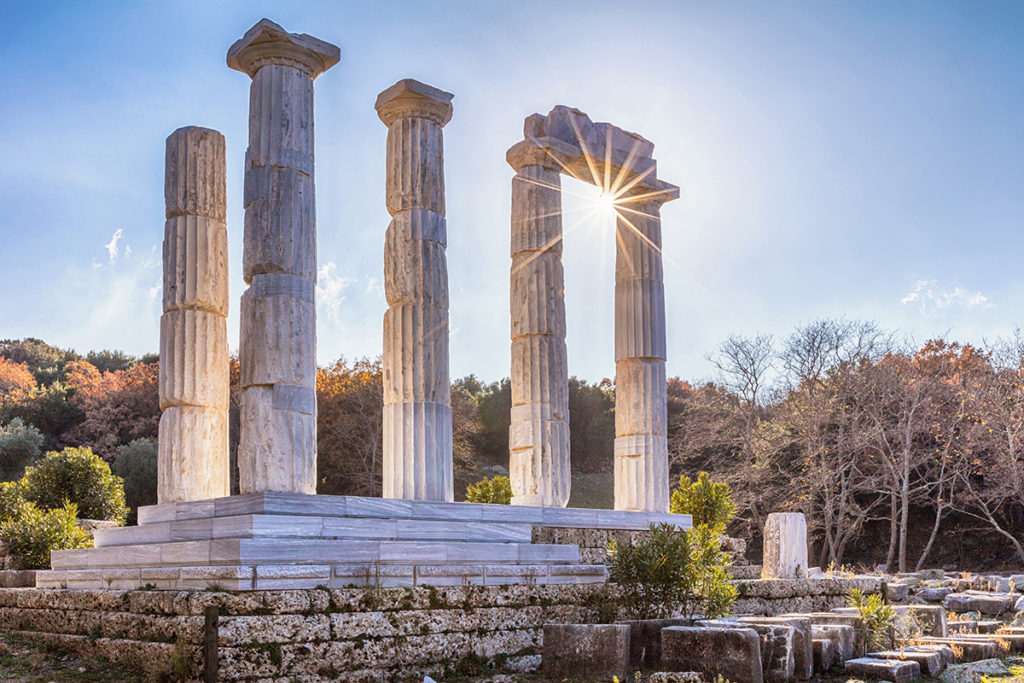
The place of discovery of the Victory of Samothrace is a curiosity in itself: the sanctuary of the Great Gods, one of the principal panhellenic sanctuaries, on the island of Samothrace. Situated in the immediate vicinity of the eponymous city, it however maintains its independence: ambassadors from the city were sent there during important events.
The cult practiced at Samothrace was recognised throughout the Greek world, and many important figures were initiated there: Herodotus, the kings of Sparta, eminent Athenians. Plato and Aristophane also make mention of it in their writings.
The sanctuary predates the arrival of the Greeks on the island (in the 7th century BCE), and the deities venerated are mostly chthonic and grouped around a central figure, the Great Mother – a woman represented with a lion beside her on Samothrace coinage. She is assimilated to the Trojan Mother Goddess of Mount Ida, as well as to the Greek fertility goddess Hestia. The names of the deities present are secret – it was forbidden to pronounce them in the profane world – and their nature remains largely enigmatic. That of the Great Mother has been revealed to us by Herodotus: Axiéros, meaning “The Worthy”.
Other deities present have been associated by the Greeks with their own Gods, in order to venerate them in this particular place. Thus, Hecate and Aphrodite, under the name of Zerynthia, were detached from the cult of the Great Mother to be venerated by the Greeks. Kadmylos, husband of Axiéros, was assimilated to Hermes. He is accompanied by male demons, the Cabires, probably at the origin of the legendary heroes founders of the mysteries of Samothrace and becoming for the Greeks the Dioscuri, protectors of sailors. Finally, a couple of infernal Gods, identified with Hades and Persephone, perhaps does not belong to the original pre-Greek pantheon.
The Victory of Samothrace, within this ensemble, is considered an offering made to the Great Gods in thanks for a naval victory. The dedication is probably Rhodian rather than Macedonian, if one is to believe the origin of the marble blocks constituting notably the prow of the ship.
The last restoration of the Victory of Samothrace took place in 2014, without the sculpture being moved further than a few dozen metres: it must be said that the goddess and her base are made up of no fewer than 200 marble blocks, for a weight of 29 tonnes! The emotion remains whole when one glimpses it, majestically welcoming the visitor as formerly the pilgrims. Visit in person, wonder guaranteed!