A weekend in Marseille in 10 unmissable activities
If you're planning to spend a weekend in Marseille, France's second-largest city by population (868,000 in 2018) and founded in 600 BC by Greek merchants from Phocaea, organising your time will not be easy. The many treasures on offer open up a range of possibilities, whether cultural, architectural, culinary or related to the stunning natural surroundings nearby.
If you’re planning to spend a weekend in Marseille, France’s second-largest city by population (868,000 in 2018) and founded in 600 BC by Greek merchants from Phocaea,** organising your time** will not be easy. The many treasures on offer open up the field of possibilities, whether cultural, architectural, culinary or related to the stunning nature surrounding the city. To help you make your choices, we’ve selected 10 things to do, which we consider unmissable for anyone discovering the Phocean city.
#1 Exploring the markets
Let’s begin with an undeniable attraction for all lovers of good food: wandering through the city’s markets. Two in particular constitute attractions in their own right, due to their atmosphere and the diversity of products on offer.
The fish market
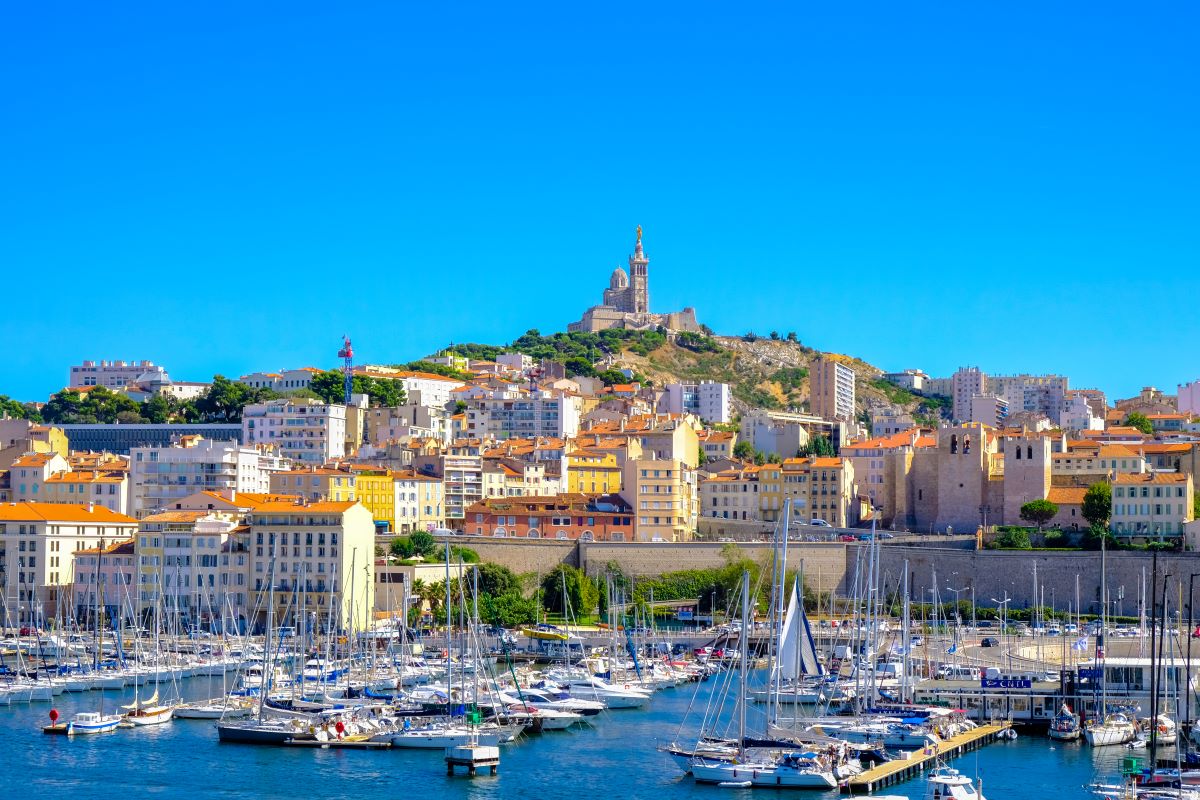
To get a feel for the Marseille atmosphere, don’t hesitate to start at the Quai de Fraternité in the Vieux-Port and its fish market fishermen, who come to sell at auction the catch from their nocturnal sea expedition.
Such an early morning stroll, in the seaside sun and with views of the boats, will help reveal the authenticity of this city with its wonderfully rich history. Before leaving, admire the ombrière and its mirrors, and use this atypical construction to take some unusual photographs!
The Noailles market
In the same vein, the 1st arrondissement will welcome you from Monday to Saturday at the Capucins (or Noailles) market. A very popular place with an exotic feel, you’ll spend an exceptional moment intoxicated by the aromas of spices, fruits and vegetables competing in freshness and quality.
Before leaving, visit two shops founded in the early 19th century: the Père Blaise herbalist shop and the Empereur hardware store.
#2 Notre-Dame de la Gard
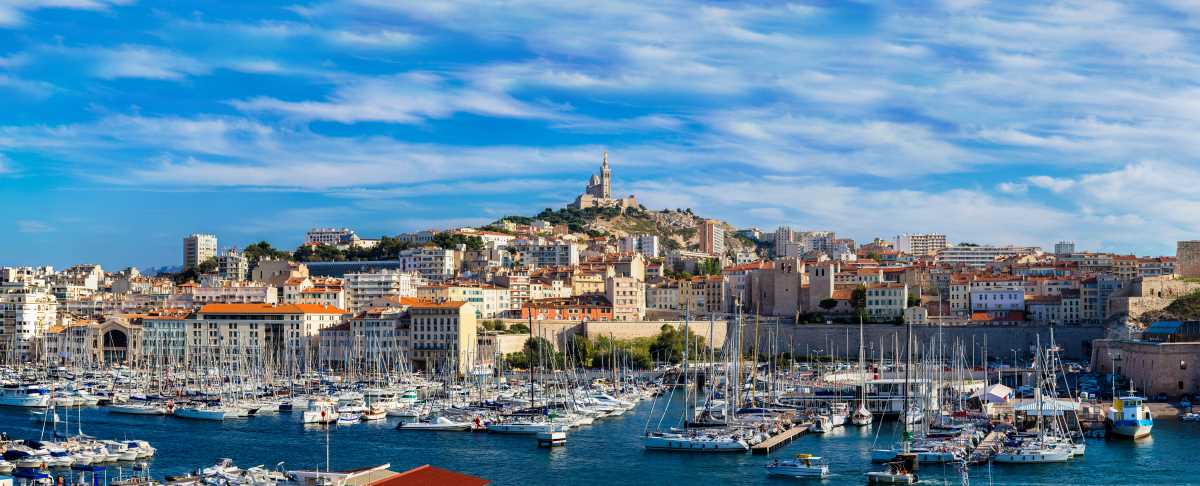
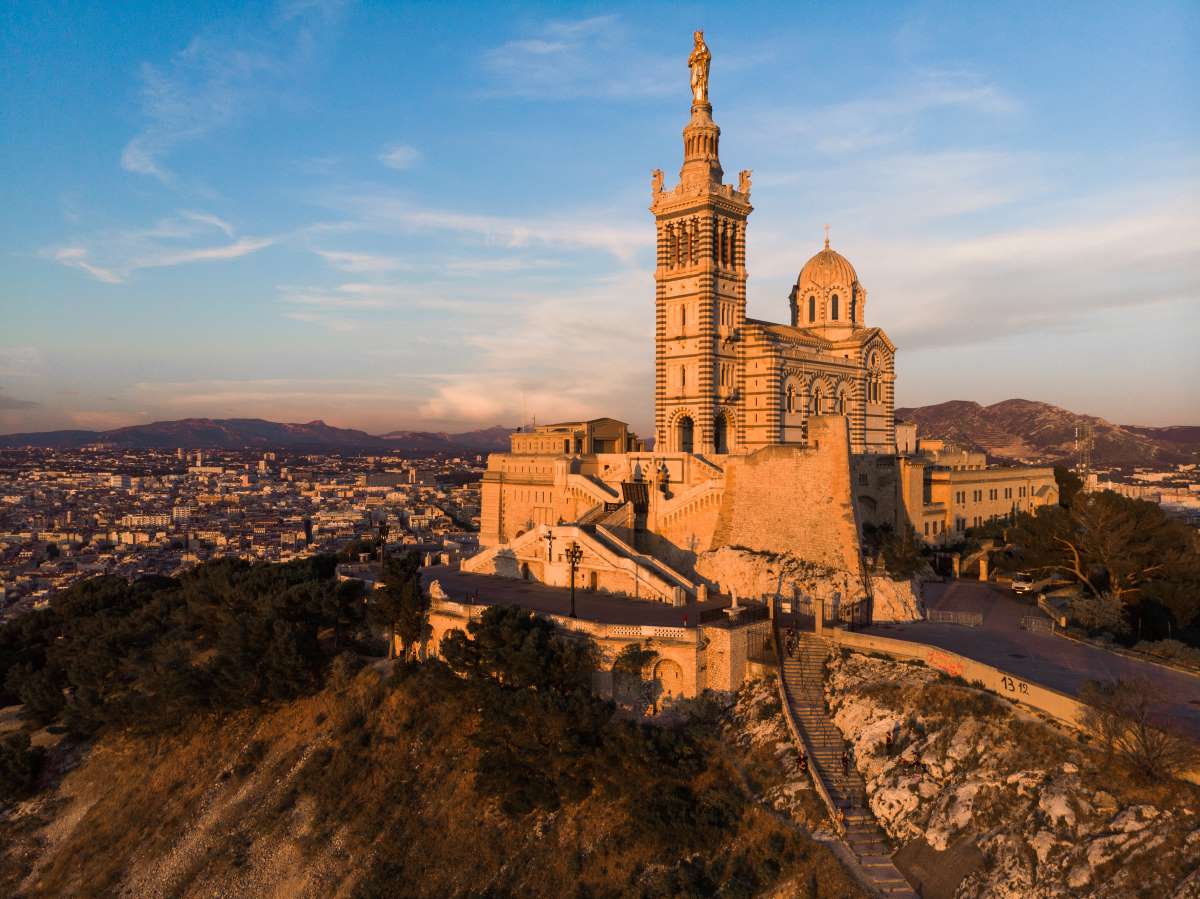
Let’s move on to more architectural pursuits with a visit to the Basilica of Notre-Dame de la Gard, nicknamed the “Bonne Mère” (Good Mother) by the Marseillais. It was consecrated in 1864, after being built in a Romano-Byzantine style by the Protestant architect Henri-Jacques Espérandieu to replace a chapel dating from the 13th century. Over the course of history, the site was reinforced by the walls of a fort, which enabled the elevation of the current basilica. Since the Middle Ages, the building has been considered the guardian of sailors and fishermen.
#3 The MuCEM
Let’s continue with the MuCEM – or Museum of European and Mediterranean Civilisations – inaugurated in 2013 when Marseille was the European Capital of Culture. You can discover scale models of Marseille from different periods since Antiquity, a piece of the Berlin Wall, a bookshop with 30,000 books and, of course, numerous collections on display in permanent or temporary exhibitions. Notably, there is an impressive collection of 350,000 photographs and 200,000 posters.
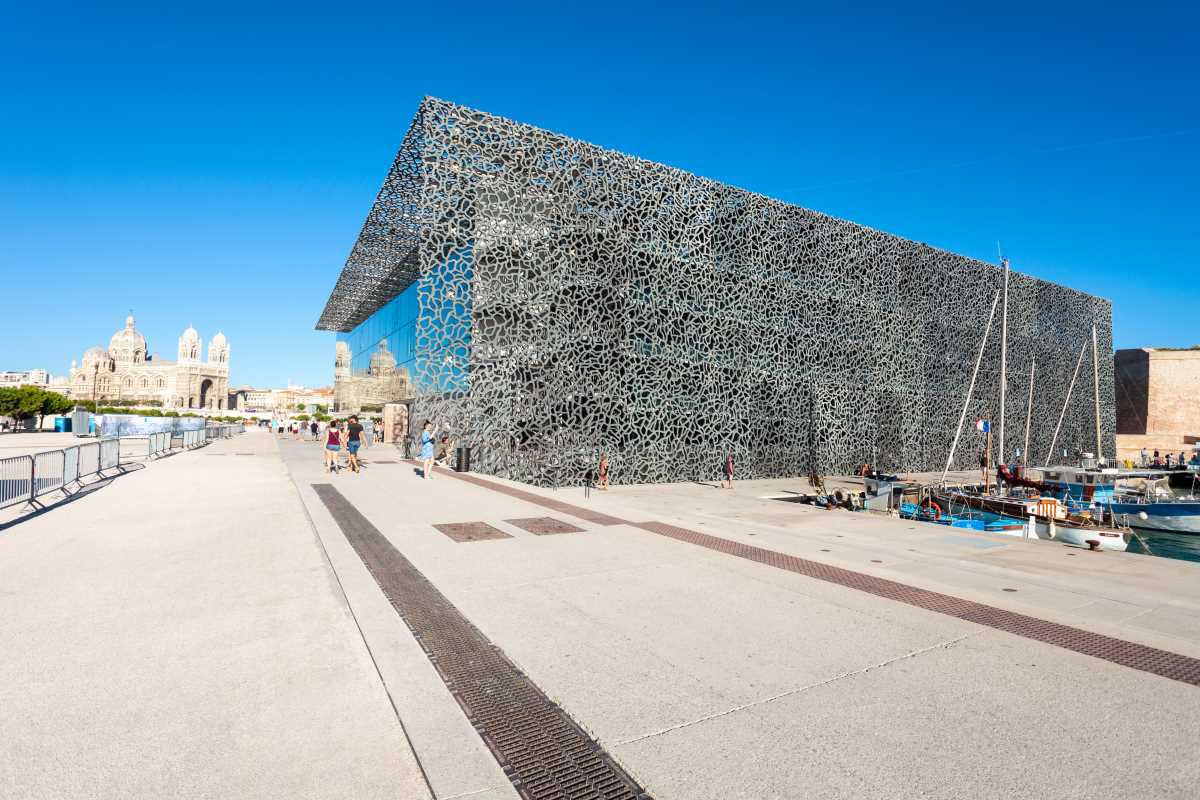
The exterior walkways also offer breathtaking panoramas. Taking the one overlooking the sea will allow you to access Fort Saint-Jean and its fantastic view of the Vieux-Port.
#4 The Panier district
As you wander through the streets of Marseille, don’t hesitate for a second to guide your steps towards the Panier district, certainly the most picturesque in the city. Also the oldest, as this is where the Greek merchants’ city was once established. Interestingly, the Mistral district featured in the TV series Plus belle la vie is directly inspired by the Panier. A pleasant friendliness reigns here, thanks to the narrow colourful lanes, designer boutiques and numerous café terraces along the route. However, beware: those allergic to stairs should give it a miss!
#5 Cours Julien
This district, not far from the Vieux-Port, is one of the most lively in Marseille, day and night. Until the 1960s, it was the hub of wholesale and retail fruit and vegetable sales. The desire to ease congestion in the city centre led to these activities being relocated to the Arnavaux district, and the Cours Julien spaces were thus taken over by various artists and ancillary activities.
Numerous art galleries, designer boutiques or music-related shops, vintage stores, restaurants and bars, combine with musicians and street artists to make it a very popular cosmopolitan spot. A genuine street art escape awaits you there too, thanks to its open-air artist gallery.
#6 Vallon des Auffes
When hunger strikes, you’ll find at the Vallon des Auffes a perfect setting for an enchanting meal among colourful cabanons and typical boats. This small traditional harbour is a haven of peace, wedged between two cliffs and seemingly frozen in time. It is said to gather the best restaurants in Marseille.
Facing the sea and the undisputed domain of fishermen, the Vallon des Auffes takes its name from alfa – orauffo in Provençal – which is a granule used to produce ropes for fishing boats (among other things). An immersion in authenticity awaits you there!
#7 La Major Cathedral
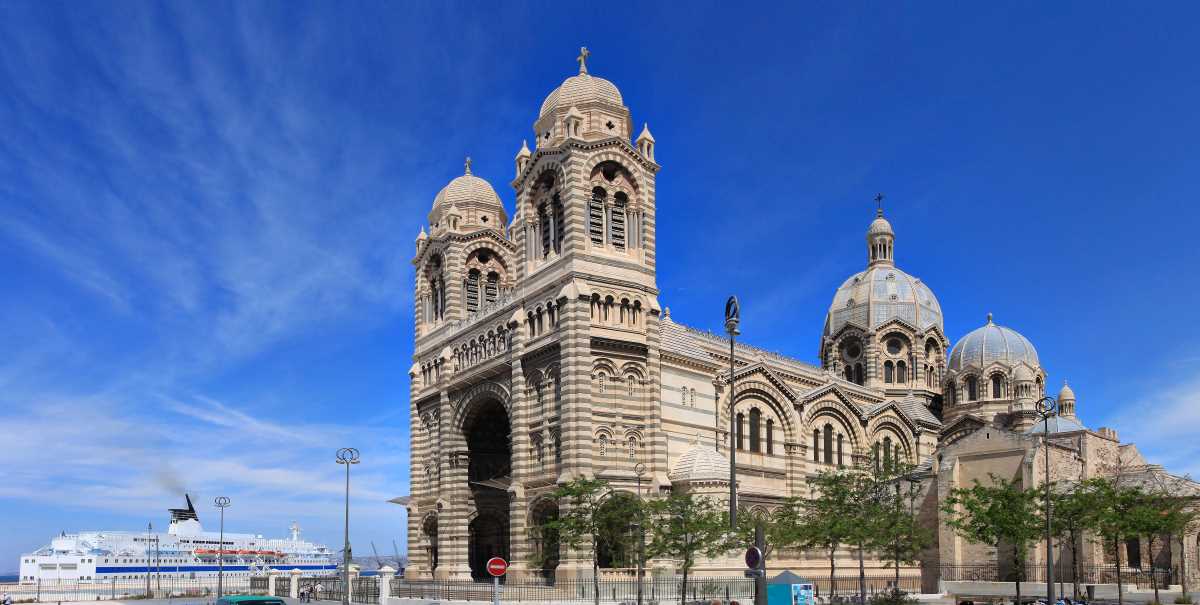
Let’s return to Marseille’s architecture, with Saint-Marie-Major Cathedral, nicknamed La Major by the Marseillais and designed by architect Léon Vaudoyer. Completed in 1893 after Louis-Napoléon Bonaparte laid its foundation stone in 1852, this Neo-Byzantin style building stands at La Joliette, whose commercial port allowed all ships from around the world to marvel at the city’s power.
The largest cathedral built since the Middle Ages, its dimensions comparable to those of St Peter’s Basilica in Rome enable it to accommodate 3,000 people. Including you!
#8 The Prado beaches
A little further south, a well-deserved rest awaits you at the Prado beaches. Marseille’s largest beach is artificial, and was developed in the 1970s to utilise the unexploited coastline. Sitting on the sand or at a café terrace, you can admire the many watersports enthusiasts meeting at the water or at the Marseille bowl. Lawns allow for other family games, and if the heat is on, the unusual aromas from the local ice cream shops will delight all palates.
#9 The Frioul Islands
Less than three kilometres from the coast, the Frioul islands constitute one of Marseille’s 111 districts. There are four of them: Pomègues, Ratonneau, Tiboulen and If, on which François I had a fortress built in 1516 (the Château d’If) whose isolated location quickly gave it status as a prison. It remained so until 1890 and opening to the public.
These are the islands that inspired Dumas for the adventures of Edmond Dantès. Around and within them, numerous vestiges and great natural riches can be observed, with endemic flora and developed fauna, particularly in terms of birds. They also belong to the Calanques biodiversity reserve.
#10 Calanques Natural Park
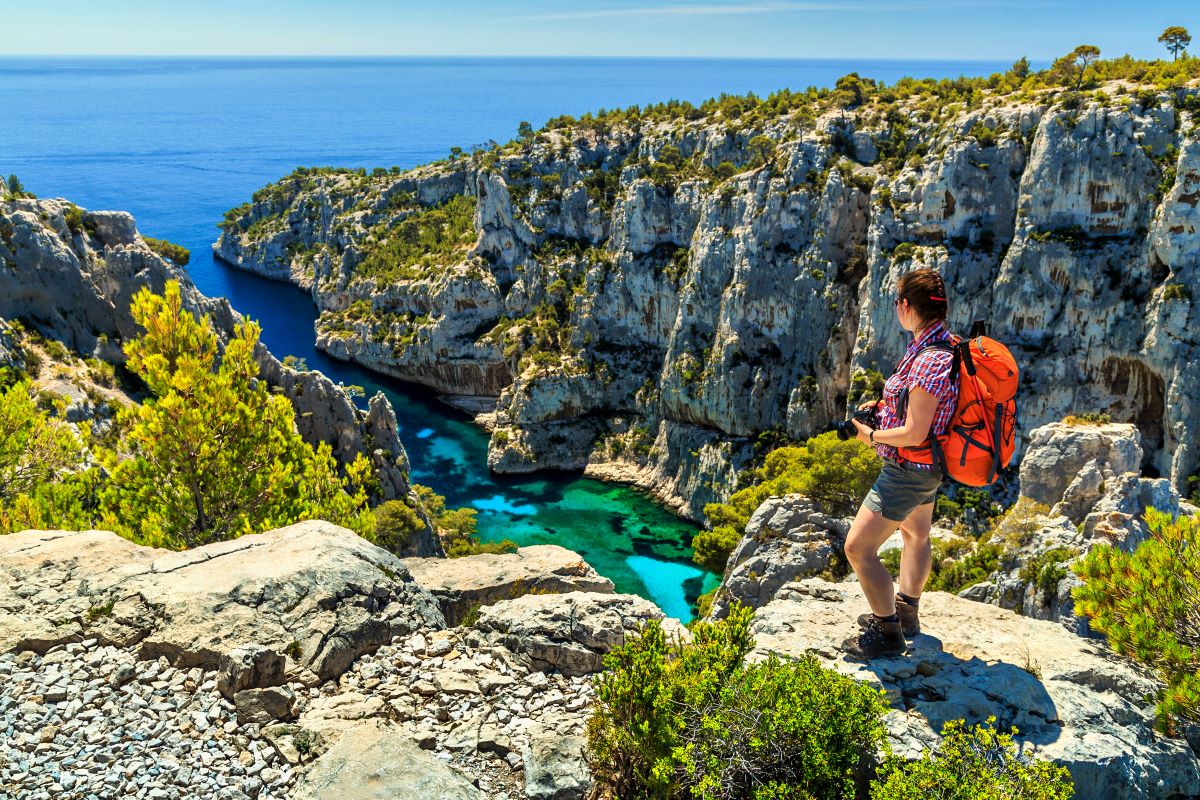
It is impossible to leave Marseille without visiting the sublime Calanques National Park, a term from Provençal calanco meaning “steep”. For the uninitiated, these are narrow but deep inlets carved into the limestone rock by the sea, often aided by a river bed. A stretch of coast 20 kilometres long and four kilometres wide, with its own ecosystem: the friable limestone and extreme aridity are not conducive to vegetation, and numerous scree slopes can be seen everywhere: it’s difficult to find flat ground.
Many walkers, hikers and climbers love this particularly special place, which deserves an hour or two of your time, if only to swim in its paradise-blue water…
Marseille holds many surprises for tourists unaccustomed to finding tranquility in an urban environment. Special mention for this city that has become one of the largest in France, acquired industries, business districts and captivating heritage while preserving a natural park on its doorstep, picturesque spots and a village-like authenticity. One weekend probably won’t be enough to explore every wonder mentioned here, but don’t worry: you can always return!