Van Gogh's Starry Night, More Colour Than Darkness
For some, it represents his greatest masterpiece. Others will also suspect that the Starry Night reflects the psychological difficulties experienced by Van Gogh, which led to his suicide at the young age of 37. One thing is certain: the postimpressionist work leaves no one...
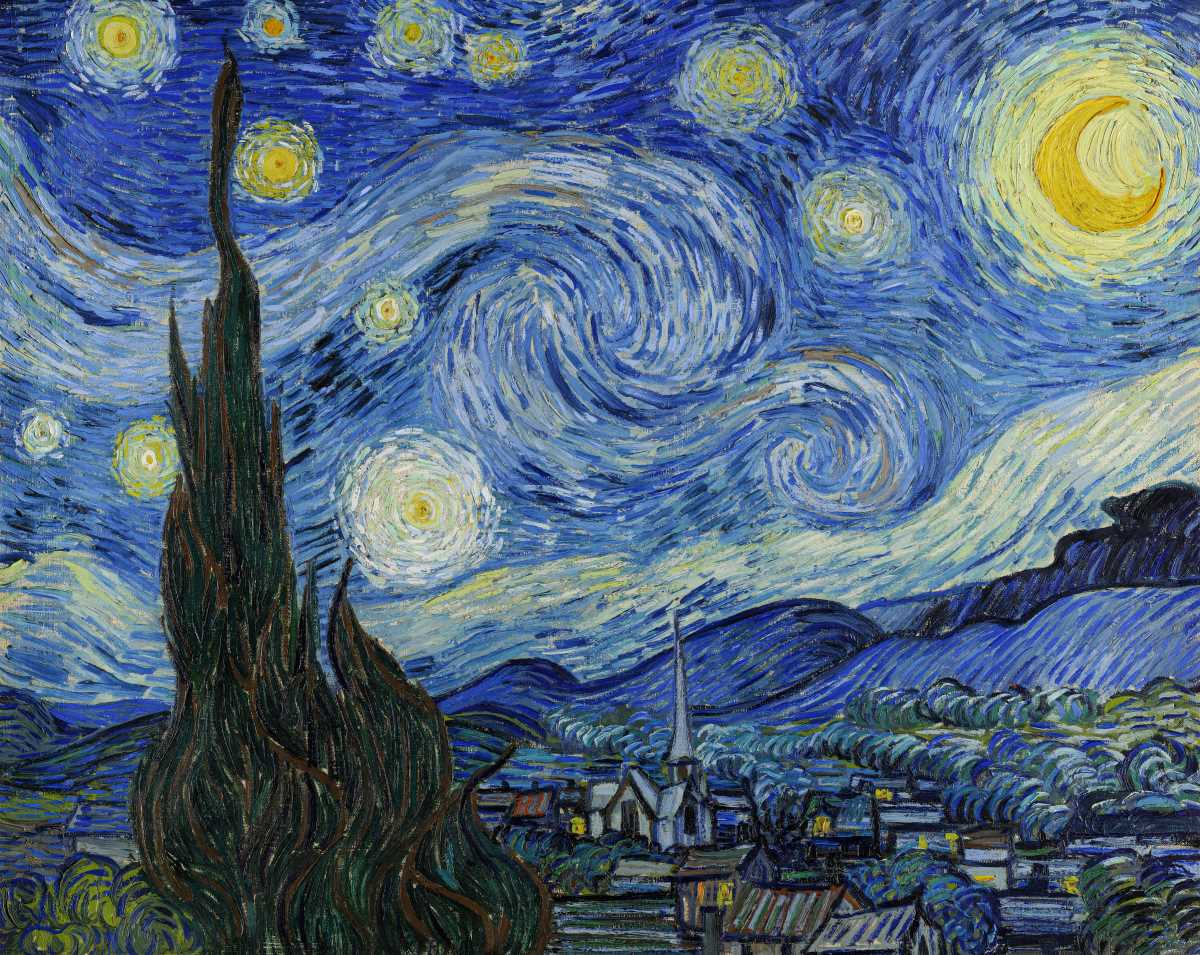
For some, it represents his greatest masterpiece. Others will also suspect that the Starry Night reflects the psychological difficulties experienced by Van Gogh, which led to his suicide at the young age of 37.
One thing is certain: the postimpressionist work leaves no one indifferent, as it transmits a vision of the night more serene than usual, as if it were an invitation to contemplation and meditation. At the same time, perhaps the painter removes himself from his drawing, feeling like a stranger to the life unfolding within it – or to the world in general. It should be noted that two Starry Night works were produced by the artist, the first in 1888, which we will discuss here, and the second the following year.
Van Gogh, Intrigued by the Stars
Vincent Van Gogh was therefore born in 1853 and died in 1890 in the arms of his brother Theo, after shooting himself in the chest and suffering for two days at the end of July. Two years earlier, his arrival in Arles in February 1888 apparently saw the artist become particularly interested in the night and consider materialising on canvas what he saw of beauty in it.
Several writings testify to this preoccupation in the months that followed. To his brother Theo, he stated he wanted “a Starry Night with cypresses or, perhaps, above a field of ripe wheat”. To his painter friend Emile Bernard, he expressed frustration: “But when will I finally paint the starry sky, the painting that always preoccupies me?” Then, in a letter to his sister Wilhelmina, he stated: “I now absolutely want to paint a starry sky. It often seems to me that the night is even more richly coloured than the day, coloured with the most intense violets, blues and greens. When you pay attention, you will see that some stars are lemon-coloured, others have pink, blue, bluebell fires. And without elaborating further, it is obvious that to paint a starry sky it is not at all enough to put white dots on blue-black”
A Work That Gives Colour to the Night
The assessment shared with his sister in this letter led Van Gogh to take action in September 1888. Wisely choosing a spot on the banks of the Rhône that allowed him to capture the reflections of gas lighting on the river water, he transposed the night colours he perceived. They were predominantly blue tones: Prussian blue, ultramarine or cobalt. The clear sky at the horizon, illuminated by the city, grew darker towards the firmament. As for the stars depicted, they glittered like diamonds, and some formed an easily recognisable figure: the Great Bear.
The city’s lights appeared orange on the water’s surface, cutting sharply through the darkness and animating the panorama. A couple on the jetty reinforced the impression of serenity emanating from the whole and contributed to making night a romantic and gentle time, rather than a subject for worry.
The significant space given to the night sky may also evoke the insignificance of human beings against the immensity of the sky. The same observation can be made regarding the width of the river. The city appears only as a thin strip, a unfolding of brief human life. In any case, the painting appears less dark than other works dealing with night at the same time, such as Summer Night completed in 1890 by Winslow Homer.
The Destiny of the Painting
For anecdote’s sake, the thoroughly Mediterranean tranquility emanating from the canvas is not comparable with the agitation inhabiting the painter’s mind. In December 1888, he thus threatened Gauguin with a razor blade, before turning it on himself to cut off his ear.
Once completed, the Starry Night was first exhibited in 1889 alongside another Van Gogh painting, the Irises, at the annual exhibition of the Société des Artistes Indépendants in Paris. You will find it today, still in the capital, at the Musée d’Orsay.
Vincent Van Gogh left behind an impressive production of 900 paintings and 1,100 drawings and sketches. Upon his death, his brother inherited everything, then his wife when he died, Johanna Bonger-Van Gogh. While the collection did not then have great market value, Johanna and Van Gogh’s circle set about making his talent known, and his letters were first published in journals, then in book form.
The panorama fixed by Van Gogh over 130 years ago in the Starry Night still exists today. A photograph attests to this, which is strikingly similar to the painting. To admire the work, therefore, two choices are open to you: visit the Musée d’Orsay, or the banks of the Rhône!