The Feast of Herod: a stone painting, with 3D effect!
You are probably accustomed to admiring paintings and sculptures, but have you ever contemplated the marriage of the two, a stone painting representing a scene worthy of the great masterworks? You can fill this potential gap thanks to the Lille-based painter Jean-Baptiste…
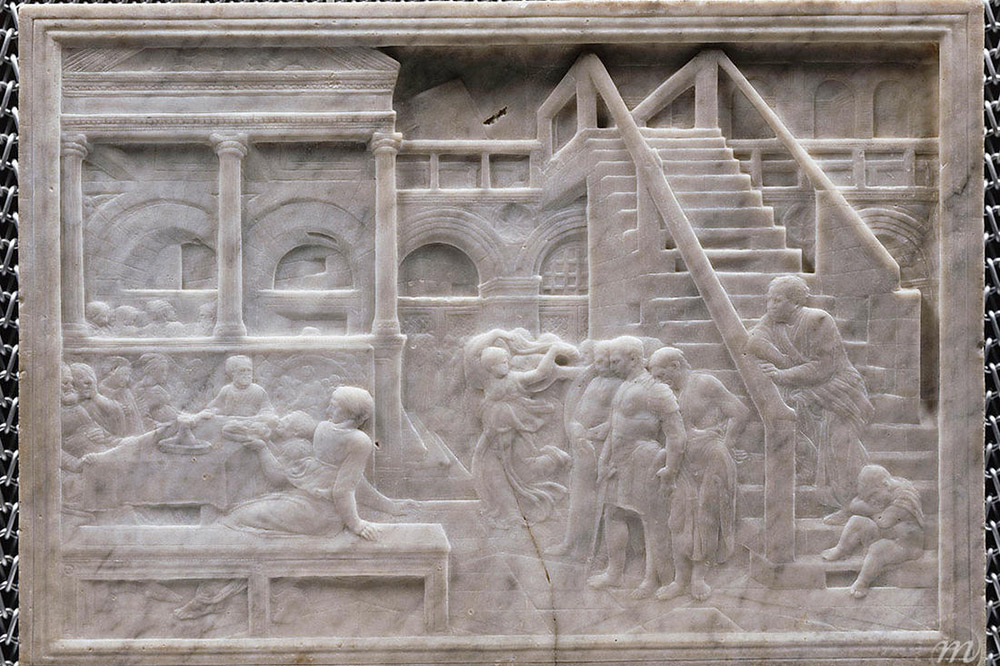
You are probably accustomed to admiring paintings and sculptures, but have you ever contemplated the marriage of the two, a stone painting representing a scene worthy of the great masterworks?
You can fill this potential gap thanks to the Lille-based painter Jean-Baptiste Wicar, who acquired the Feast of Herod, sculpture by Donatello unrivalled in France, before bequeathing it to the Society of Sciences, Agriculture and Arts of Lille in 1834. It is now exhibited at the Palais des Beaux-Arts of the capital of Flanders.
The work was probably commissioned from the sculptor by Cosimo de Medici, a powerful figure in Florence and art connoisseur. It appears in the inventory of goods belonging to his grandson Lorenzo de Medici, known as “the Magnificent”.
Two scenes in one, the story of a tragedy
Inspired by the Gospels, the Feast of Herod denounces the murder of Saint John the Baptist, who baptised Jesus Christ. According to the narrative, King Herod Antipas entered into an incestuous marriage with his sister-in-law Herodias, denounced by John the Baptist, who was imprisoned for this.
On the right-hand side of the sculpture, Salome, daughter of Herodias, performs an enthralling dance in the palace courtyard, observed by the crowd and the executioner. It was Herodias who supposedly encouraged her to seduce Herod, in order to obtain his favours. She was to satisfy her mother’s vengeance by demanding the head of John the Baptist.
On the left, the other part of the scene reveals a banquet during which the saint’s head is presented to Herod on a platter. In the foreground, a young woman – probably Salome – can be seen, horrified at what she sees.
A technical feat by Donatello
Donatello, the greatest sculptor of the Italian Renaissance, demonstrates exceptional expertise here. He notably employs the technique of rilievo stiacciato (flattened relief) of which he is the inventor, as well as Alberti’s laws of linear perspective. This perspective uses a single vanishing point, creating the illusion of depth on a painting that is nevertheless predominantly two-dimensional.
Up to eight successive planes are used to imprint the scene in its smallest details on just one centimetre of depth. The numerous details of the background architecture enrich the impression of reality, while the expressions on the faces convey the strong emotion expressed by the two scenes. The impression of three-dimensional vision is striking.
Regarding the stylistic choices of the representation, note that the term Renaissance refers to the rediscovery of Antiquity by artists of the 15th century. The draped garments worn by the guests, the armour and the architecture of the site are inspired by it.
To discover at the Palais des Beaux-Arts in Lille!
Outside Paris, the Palais des Beaux-Arts in Lille is the largest fine arts museum by number of works on display. It occupies a sublime 19th-century building of 22,000 m², with a surface area of 12,000 m² dedicated to exhibitions. The visible collections are numerous:
- European painting with works by Rubens, Van Dyck, Goya and Delacroix;
- French paintings by David, Courbet, Puvis de Chavannes, among others, for a total of more than 1,500 paintings presented within the museum;
- 19th-century sculptures by the famous Rodin, Claudel and Carpeaux, among others;
- 17th and 18th-century ceramics,
- a Medieval and Renaissance department,
- an important cabinet of drawings and photographs, comprising 40 sheets by Raphael and others by Michelangelo;
- 18th-century scale models, of about fifteen fortified towns by Vauban in northern France and Belgium.
Several guided tours are offered, of variable approximate duration and aimed at lingering on various themes. You can thus admire the “beau gosses”, follow the “at table” route, the “animal stories” or find out about ar(t)chitecture.
The Feast of Herod, as you will have understood, is among the unique treasures to discover in this superb Lille museum, but it is far from constituting its only attraction. Essential visit for any art lover, it is a logical step for those seeking to complete their culture after visiting the Louvre and the Musée d’Orsay, among others.
Please note, the Palais des Beaux-Arts in Lille is closed on Tuesdays and certain public holidays. Enjoy your visit!