Real Estate: Ideal for Your Investor Profile?
Growing your savings, increasing your wealth, preparing for retirement or making your investments and holdings the main source of your income all have this in common: they are objectives pursued by investors of all kinds. Because there are indeed several kinds, or rather investor profiles, who must choose between the possibilities offered by equally many markets with their own characteristics. It is a question of risks to take, annual returns or indeed, preserving the investment. We shall focus here on real estate and, within it, the most effective way to invest according to your profile. The goal: to help you see more clearly, so you can make the investment that best suits you!

Growing your savings, increasing your wealth, preparing for retirement or making your investments and holdings the main source of your income all have this in common: they are objectives pursued by investors of all kinds.
Because there are indeed several kinds, or rather investor profiles, who must choose between the possibilities offered by equally many markets with their own characteristics. It is a question of risks to take, annual returns or indeed, preserving the investment. We shall focus here on real estate and, within it, the most effective way to invest according to your profile. The goal: to help you see more clearly, so you can make the investment that best suits you!
The Different Investor Profiles
Let us begin by shedding light on how different investors operate, which can be split into 3 categories.
The Cautious Profile
This person seeks above all to earn a little money, a supplementary income, without taking any risk with their assets. These are often elderly people, or families for whom the financial balance must remain stable and who cannot afford to see part of their investment lost.
Seeking significant gains is therefore not the order of the day here, since in matters of investment, performance is often synonymous with risk – but not always, as we shall see.
The Dynamic Profile
In contrast to the above, the dynamic-profile investor will seek to maximise the possibility of gain, even at the risk of losing their initial stake – although this is not their wish, of course. This category most often includes people under 40, rather single, with a comfortable level of income: the money they invest is not, in the immediate term, vital for them.
This type of investor has a long-term vision of the investments they make, and projects (or hopes for) a large gain over 10 or 15 years. They generally take an interest in the mechanisms of the investment they set up and act as a specialist or at least, as an informed person.
The Balanced Profile
As you will have gathered, we are at the crossroads here. The balanced-type investor has a neutral tolerance for risk: they will want to benefit from decent returns, without taking the risk of losing a significant part of their investment.
For this type of investor, a loss must be temporary: they can accept losing part of their portfolio, but retain hope of seeing their gains reappear quickly. As a general rule, they already own their primary residence and are looking to invest savings that they do not need in the medium term.

How to Determine Your Investor Profile?
This is quite simple, and at the same time requires genuine introspection. It is primarily a question of determining whether you are prepared to risk your savings, or not at all. You can use the following data to help you decipher your appetite for risk:
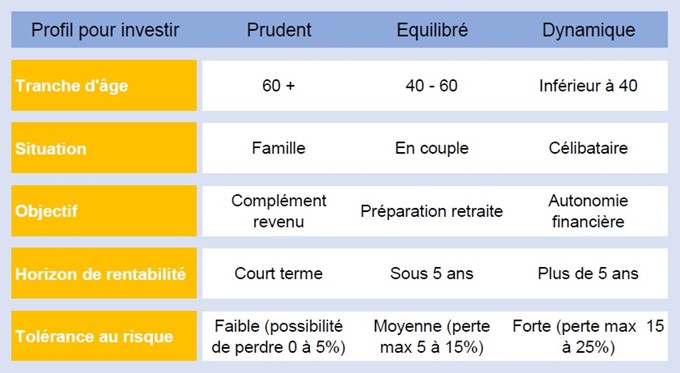
• Age: youth leads (generally) to more risk. Living standard requirements are less important and retirement seems far away: there will always be time to recover in the event of a loss.
• Personal situation: the fewer projects the investor has, the more they will be tempted to play big with their savings in the hope of earning more money. Thus, a single person without children will often have a more dynamic profile than a family father.
• The objective pursued: is it about earning money to save more? To fund retirement? To finance their children’s studies? Or simply to increase their living standard? In short: would a loss of capital be catastrophic or acceptable?
• The investment horizon: the shorter it is, the more limited the risk should be. In the case of a property project within one or two years, for example, it makes sense to keep your savings intact and therefore, limit the risks.
• Risk tolerance: this last point is personal to each individual. Some will be gambler types, while others will prefer to avoid stress.
Please note, this analysis is based on generalities which may vary from one individual to the next. An elderly person can also be dynamic in their investments, and a young person shy at the idea of losing the least amount. To score the points between the different criteria, here is a summary table:
Real Estate, Always a Safe Haven
When we talk about investment, real estate retains the overwhelming advantage of ensuring the preservation of a tangible property, whose resale is always possible and most often allows for covering a loss suffered. This is undoubtedly why more and more of our fellow citizens are turning towards this type of investment, perceived as a haven alongside the highly risky stock market investments, the sluggishness of bank savings or indeed, directly in the capital of companies with innovative concepts but uncertain futures.
The numbers speak for themselves: in 1968, property sales – and consequently investments of the same nature – represented 6% of the country’s gross domestic product (GDP). Precisely 50 years later, in 2018, they represented 13.9% of GDP. Although the health crisis linked to Covid may have slowed the market somewhat in 2020, enthusiasm remains undiminished and buyers’ appetite has to date only been dampened by the banking context and notably, the cautiousness of the usury rate.
Within real estate, we must once again distinguish several ways to invest. Some investors thinking big may attempt to build a property empire through the successive or simultaneous purchase of several properties and letting them out. Others, less demanding and no doubt with less time to dedicate, will prefer to settle for a single property which will constitute their only investment alongside savings accounts.
The LMNP: To Combine the Strengths of All Profiles
A particular way of investing in real estate, furnished non-professional lettings in serviced residences breaks the aforementioned rules: it allows for significant returns to be obtained, while eliminating all risks, or almost. Here is an explanation.
Returns Worthy of the Riskiest Investments
Thanks to a well-honed investment scheme and the attractiveness of furnished properties, particularly in senior and student residences, LMNP contracts can offer annual returns of up to 7%!
Unprecedented Security
All investor profiles have one thing in common: none like to take risks. When we talk about a dynamic profile prepared to take risks, it is not (always) a taste for risk, but rather what a person is prepared to lose if the chance of a significant gain is also present.
The flagship advantage of LMNP is its reliability: the profitability plan is assured, insofar as the contract concluded with the serviced residence operator provides for the payment of rent even in the event of vacancy of the dwelling.
A Way to Invest at Low Cost
Another piece of good news with LMNP: people looking for a furnished property to rent, particularly within themed residences (student, senior, business or tourism) will more easily gravitate towards small units. This is because it is generally a population with limited means or wishing to limit the cost of renting.
The investment strategy is all the more successful, and it is possible to find LMNP properties to acquire from €50,000. A great opportunity for all profiles, who would do well to multiply investments of this type according to their savings, instead of putting everything into a larger flat. Small savers also find a possibility of a very profitable investment, accessible to their means.

Tranquillity as the Final Note
To conclude, let us highlight the common point between LMNP investment and a simple financial investment: no intervention is necessary, you simply watch the money come in. Indeed, the serviced residence remains responsible for finding and selecting tenants, for the maintenance of the residence and for rent collection.
Real estate is a popular type of investment, but with diverse motivations: securing a small income, materialising wealth or making a significant gain, generally. With LMNP, you can add the objective of earning a lot over the long term, while retaining the property and therefore, increasing your wealth at the same time.
LMNP therefore constitutes the most straightforward way to invest, for people with little time, wanting significant returns and without taking any risk: it meets the expectations of all investor profiles!