Mona Lisa, Masterpiece of the Italian Renaissance
It has sparked endless debate (and paint), captivating countless eyes: who has not at least heard of the Mona Lisa, this famous 16th-century painting of worldwide recognition? Its history and that of its author continue to fascinate art enthusiasts and experts alike. Displayed at the Louvre Museum, it continues to attract increasing numbers of visitors keen to admire its beauty and the quality of its execution. A closer look at a painting that still arouses great passion.
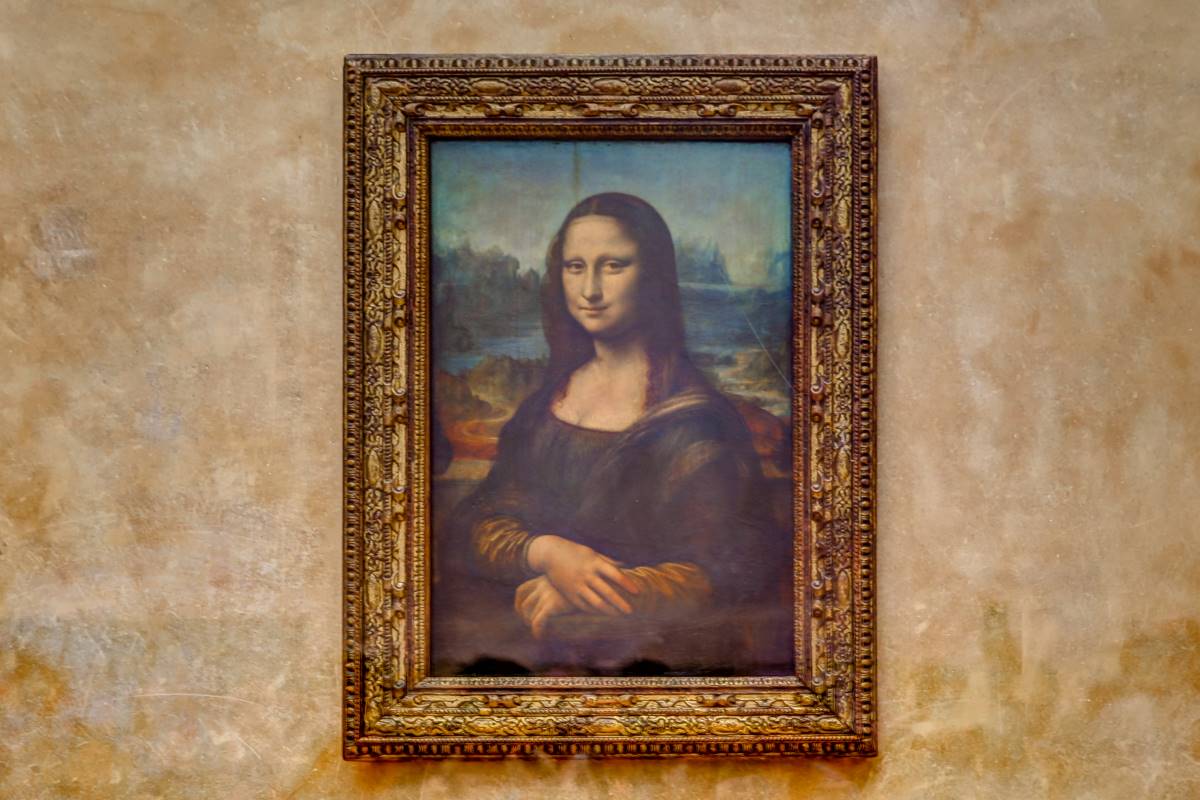
It has sparked endless debate (and paint), captivating countless eyes: who has not at least heard of the Mona Lisa, this famous 16th-century painting of worldwide recognition? Its history and that of its author continue to fascinate art enthusiasts and experts alike. Displayed at the Louvre Museum, it continues to attract increasing numbers of visitors keen to admire its beauty and the quality of its execution. A closer look at a painting that still arouses great passion.
77 x 53 cm of mystery and fascination
Many mysteries surround the history of this oil painting. First, regarding its date of creation: it was most likely completed in several phases, between 1503 and 1506 and perhaps even as late as 1519 according to some. Then, concerning the identity of Mona Lisa. It takes its name from Florentine Lisa Gherardini, wife of the Florentine merchant Francesco del Giocondo, who is believed to have commissioned a portrait of his wife from Leonardo da Vinci. However, another version involves Giuliano de’ Medici, ruler of the Florentine Republic: the female figure painted would be one of his mistresses. Whatever the case, it was at the invitation of King Francis I that Leonardo da Vinci travelled to the Château du Clos Lucé, taking the Mona Lisa with him. The king then acquired it in 1518.
Almost four centuries later, in 1911, the masterpiece was stolen from the Louvre by Vincenzo Peruggia, and it took two years to see it returned to the museum. The Italian culprit is said to have acted out of patriotism. This misadventure for the Mona Lisa, however, served to increase its popularity and fame throughout the world.
Beyond its origins, it is the technical characteristics of the Mona Lisa that have continued to fascinate many artists throughout history. Indeed, Leonardo da Vinci employed remarkable methods to create one of the most studied works in the world. The portrait is framed in a way that was very modern for the period, and the optical effects lead the viewer to believe that Mona Lisa never takes her eyes off them. The technique of sfumato, “smoky” in Italian, invented by Leonardo da Vinci, which involves superimposing several layers of paint, creates this hazy appearance and gentle perspective that everyone can observe when admiring the work.
Leonardo da Vinci: an artist with many facets
Born in 1452 in Vinci (Tuscany), son of a peasant woman and a notary, it was his paternal grandparents who raised Leonardo da Vinci until he was 10 years old. His father then enrolled him in Florence at a “scuola d’abaco” (an Italian school whose curriculum focused primarily on mathematics and algebra). He continued his education at the workshop of Andrea del Verrochio where he met Italian painters who would become famous (Botticelli, Perugino and Domenico Ghirlandaio). When he left the workshop in 1482, he managed to gain entry to the court and received a few painting commissions that enabled him to open his own studio. Leonardo da Vinci was passionate, and eventually mastered several arts such as sculpture, drawing, music and painting.
He viewed painting as a science, analysing the subject to be painted from different angles, making sketches. Among his key works, we find of course the Mona Lisa, but also The Virgin and Child with Saint Anne, which brings together three generations in a moment of sharing and love, Saint John the Baptist, which would be the artist’s artistic testament, and the Vitruvian Man, the famous drawing representing the ideal proportions of the human body.
A genius of the Renaissance, beyond his talent as a painter, it is his talent as an engineer that made him famous. He considered himself an engineer, scientist and architect. Of a curious nature, the artist was interested in many aspects of science including geology, hydrodynamics, astronomy and anatomy, which allowed him to better understand life and the world around him. His lack of university training gave him a certain freedom of thought and application of his genius, far from the academicism of his era.
In 1519, at the age of 67, Leonardo da Vinci passed away at the Château du Clos Lucé, leaving behind many works and inventions that would be extensively studied – dissected even – in the centuries that followed.
The Louvre, a first-rate museum that houses many masterpieces
Some works by Leonardo da Vinci, including the one that concerns us today, can be admired in the majestic Louvre Museum. Opened in 1793 under the name “Muséum central des arts de la République”, it was the collections of the kings and then the representatives of the republic, and those ceded by conquered countries that formed the treasure now on display at the museum. This also served as a training place for artists until 1803.
The Louvre is nowadays the most visited museum in the world with its 10 million visitors in 2018. On entering the glass pyramid by Pei (built in 1989), located in the middle of the Cour Napoléon, the visitor discovers an exhibition surface of 72,735 square metres, with 36,000 works on view among the 500,000 in the collection. There is Western art, from the Middle Ages to the revolution of 1848, as well as works from ancient Oriental, Egyptian, Greek, Etruscan and Roman civilizations, graphic arts and Islamic art. Many of the most famous works in the world are found there: in addition to the Mona Lisa, visitors will discover the Venus de Milo, the Winged Victory of Samothrace, the Seated Scribe or The Raft of the Medusa.
For the more adventurous, the museum offers evening openings that plunge the visitor into a subdued atmosphere and offer striking illuminated views of the architectural wonders that make up the palace and its surroundings.
Appreciation of art does not preclude digital innovation, and an immersive experience awaits those wishing to discover or rediscover certain works through virtual reality. Indeed, the Louvre thus allows its visitors to learn more by getting closer to the painting – not to be attempted in reality! The virtual allows for feats: Mona Lisa standing tall, suddenly emerging from her painting’s setting, while the guide tells you the history and techniques used in its creation.
Leonardo da Vinci’s work is immense, and studying it yields many learnings. Painter, architect and engineer, this avant-gardist left us a precious heritage that everyone can appreciate at its true worth, thanks in particular to the specialists and museums that allow the greatest number to approach and understand it, each in their own way.