The Wedding at Cana: a banquet that challenges the conventions!
Commissioned in 1562 by a Benedictine monk from the San Giorgio Maggiore monastery in Venice, the painting The Wedding at Cana was commissioned to decorate the refectory. The contract surprisingly states that its painter Paolo Veronese "may include as many figures as it will be possible to include in the painting".
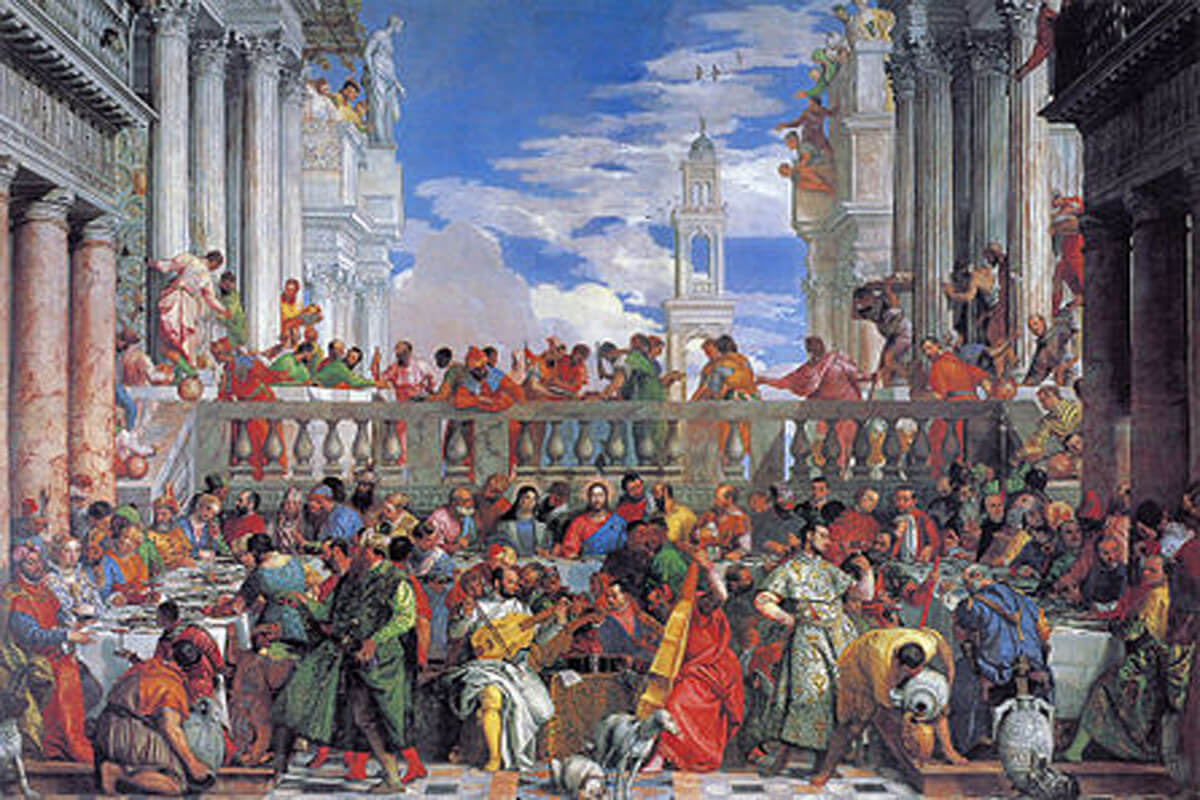
Commissioned in 1562 by a Benedictine monk from the San Giorgio Maggiore monastery in Venice, the painting The Wedding at Cana was commissioned to decorate the refectory. The contract surprisingly states that its painter Paolo Veronese “may include as many figures as it will be possible to include in the painting”. Having become French heritage following Napoleon’s first Italian campaign and the signing of the Treaty of Campoformio, the Muséum central des arts – now the Louvre – took possession of it in 1798. A look back at the specificities of a majestic work in every sense.
A masterpiece of extraordinary dimensions for a miraculous story
Paolo Veronese’s creation never ceases to amaze, first and foremost through its dimensions: 6.77 by 9.94 metres, making it one of the most imposing old paintings in the Louvre’s collections, or even in France.
This size accommodates no fewer than 130 brightly coloured figures. The scene depicted is an episode from the New Testament. Jesus and his mother Mary are invited to the wedding and occupy its centre in place of the newlyweds, surrounded by disciples, princes and aristocrats, common people and servants. The newlyweds can be found seated – relegated? – at the end of the table.
It is on this occasion that Jesus, topped by his blazing halo, performs his first miracle: turning water into wine when it runs out. In the lower right of the painting, one can see the servant emptying wine from a stone jar normally filled with water, into a pitcher intended for wine. The steward of the house, elegantly dressed in silk, gazes in disbelief at his glass filled with wine handed to him by his accountant assistant, recognisable by his red stick. He well knows he has not paid for this wine.
Anachronism was common at the time, and we find Jesus in a setting and surrounded by figures typical of the 15th century. Among them, contemporaries of the artist can be recognised, such as the painters Titian and Bassano.
An interpretative challenge
At first glance, Paolo Veronese’s work seems intended to shock Christian morality. The presence of Jesus and Mary in the midst of a disparate and colourful assembly questions the respect shown to them, all the more so as the work was destined for the common room of a monastery.
A more careful study reveals that Jesus is truly the centre of the entire scene, and the only character to directly fix the viewer with a look imbued with deep reflection. All the converging lines of the painting lead back to Jesus, at the centre but as if exterior to the scene, an observer who questions us about our relationship to the situation, one might imagine.
The painter has also respected, in form, religious beliefs: if the guests on the left are feasting abundantly, the monks on the right have empty plates and must not have eaten much, proof that they have not succumbed to the sin of gluttony.
Finally, the sky occupies a vast space in the painting, as if to signify that the essential lies elsewhere than in worldly celebration. The newlyweds, who seem frozen amid the other guests in agitation, may raise the question of the presence of genuine love in the smiles exchanged by the guests of the scene. One may think of a denunciation of superficiality and an invitation to return to simple things.
The symbol of power and decadence
Venice was at the time the most refined place in the West, which Paolo Veronese also seems keen to highlight, through the sumptuous festival but not only that.
A hub of Mediterranean trade and gateway to the Orient, producer of the finest glassware, every detail of the scene highlights the apogee of Venice’s power. Thus present at the banquet are characters wearing turbans, a parrot, an African servant, evidencing the far-reaching influence of the city. The Murano glassware holding the miraculous wine is visibly very fine.
One also notes, among the musicians present in the foreground and who may represent Paolo Veronese himself as well as his young brother, surrounded by the aforementioned Venetian painters, other details suggesting the decline of Venice that had already begun at the time.
The hourglass running out seems a symbol that the sumptuous festivities must soon cease. As for the dogs, they appear as a symbol of melancholy.
By combining this interpretation with Jesus’s miracle, one may think that Cana is the starting point leading to catastrophe: the end of Venetian supremacy in the 15th century, and the first step leading to the cross for Jesus once he had displayed his miraculous gifts.
Placed in the same room as the Mona Lisa at the Louvre, The Wedding at Cana appears as a major work for all of Christendom. A recent restoration – carried out on site as the painting’s dimensions made any transport delicate – has restored all its splendour.