The Royal City of Loches: from citadel to prison
Classified as a historic monument since 1862, the Royal City of Loches is one of France's treasures.
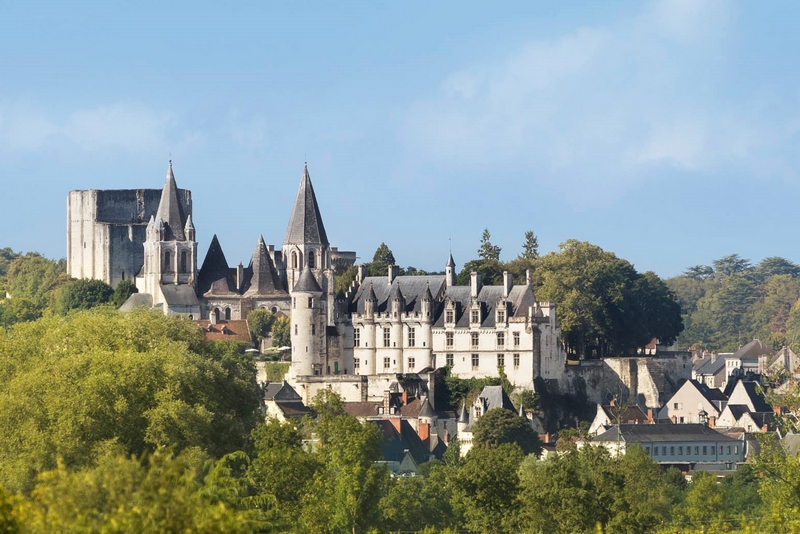
In the heart of the Loire Valley and some forty kilometres from Tours stands the Royal City of Loches. Classified as a historic monument since 1862, this heritage complex sits atop a rocky outcrop overlooking the Indre. It contains one of the best-preserved Romanesque donjons, which has been open to visitors since 1950 thanks to the Indre-et-Loire departmental council. Follow the guide!
A site with a military purpose at its outset
The earliest stone fortifications at the site of the Loches fortress date from the 10th century, although evidence attests to the presence of a “castrum” – a fortified Roman camp with a wooden keep – as early as the 5th century.
Through Louis the Stammerer and advantageous marriages, the House of Anjou acquired the lands of Loches, enabling Foulque Nerra III, Count of Anjou, to have a square keep built in the first half of the 11th century. Henry II Plantagenêt enriched the site with walls and moats that still survive today.
When Philippe Auguste inherited it in 1193 at the decision of John Lackland, the domain was conquered by Richard the Lionheart and then taken by Philip II of France in 1205, annexing it to the royal domain and thus bringing it a welcome military peace for the preservation of its walls.
A royal residence then a prison
Charles VII, King of France, was fond of the Loches fortress and visited it frequently from 1818. He made it the second royal stronghold after Chinon and met Joan of Arc there after the victory at Orléans. His stays increased, all the more so as he frequented Agnès Sorel, his favourite who was 20 years his junior and originally a lady-in-waiting to Isabelle of Lorraine, Duchess of Anjou.
Other kings also valued the Loches stronghold. Thus the royal apartments were expanded under Charles VIII and Louis XII, notably with Anne of Brittany’s oratory, a marvel of Gothic style. The Valois dynasty subsequently abandoned the site.
From a ducal residence to a royal fortress, the Loches domain was converted into a prison in the 16th century and retained this function until 1926. Philippe de Commynes, Ludovico Sforza and Jean de Poitiers were among those held prisoner there.
A diverse ensemble enriched over time
The various vicissitudes faced by the fortified domain of Loches resulted in the construction of several buildings. Between the 10th and 16th centuries, the fortress developed to reach the appearance we know today. Thus the royal apartments were established in the north, near what is called the “little keep”, alongside the main tower built by Foulque Nerra, 36 metres high and dominating the entire complex.
A Round Tower was erected in the 15th century to accommodate the cutting-edge technology of the period: artillery. The old donjon could not in fact accommodate cannons. This was followed by the Martelet, a tower with the unique feature of not being raised but rather dug out: four levels spanning 27 metres house dungeons including that of the Duke of Milan, captured in 1500 by Louis XII, who was held there and died there.
To the south, the ramparts and the three towers that adorn them were built by Henry II of England and Richard the Lionheart. Finally, a casemate called a “caponnière” was created during the Wars of Religion to defend the moats.
Filled with echoes of history, conquered and frequented by great names of French and English royalty, the Royal City of Loches today offers a visit rich in entertainment and immersion in the centuries past. Not to mention the tranquility brought by a carefully maintained medieval garden. Total change of scenery guaranteed!