Cheverny Castle, a treasure trove to admire
If you are planning a cultural stay in Sologne soon, the castles of Blois and Chambord will inevitably feature on your itinerary. A few minutes from these wonders, you will discover Cheverny Castle which, in a different style, will delight the visitor. Having belonged to the same family for six centuries with only two interruptions, it is one of the best-preserved castles in the Loire Valley. A look back at the history of the 'enchanted palace' of the Grande Mademoiselle.
If you are planning a cultural stay in Sologne soon, the castles of Blois and Chambord will inevitably feature on your itinerary. A few minutes from these wonders, you will discover Cheverny Castle which, in a different style, will delight the visitor. Having belonged to the same family for six centuries with only two interruptions, it is one of the best-preserved castles in the Loire Valley. A look back at the history of the ‘enchanted palace’ of the Grande Mademoiselle.
A fundamentally family history
A first fortress erected in the 16th century became the property of Diane de Poitiers, mistress of King Henri II. She quickly sold it to the son of the previous owner, whose descendant, Henri Hurault, together with his wife, had Cheverny Castle built as we know it today, between 1624 and 1630. The architect Jacques Bougier assisted them and retained few traces of the original dwelling. The premature death of the countess in 1635 and of Henri Hurault in 1648 left the property in the hands of their two surviving daughters (out of seven children conceived).
Interior decoration continued to evolve until 1650, after Elisabeth, marquise of Montglas, bought out her sister Anne-Marguerite’s share and enlisted the help of the Blésois painter Jean Monier to embellish the residence. It was a recognised success, with many nobles of the period enjoying sumptuous parties at Cheverny. Frequent visits from one of Elisabeth’s friends, nicknamed the ‘Grande Mademoiselle’, who was none other than the daughter of Gaston d’Orléans and who described Cheverny as an ‘enchanted palace’, are worth noting.
For a century and a half, Cheverny changed hands regularly as Elisabeth’s children lost interest. It was not until 1825 that Anne-Victor Hurault, marquis de Vibraye, acquired the dwelling of his ancestors, which was transferred to him in life annuity by Julien Guillot. Previously the property of Jean-Nicolas Dufort de Cheverny during the Revolution, the castle was spared.
Having remained the property of the Marquis de Vibraye since then, Cheverny Castle has undergone no major changes and remains richly furnished and decorated. It has become one of the most visited castles in the Loire Valley, with 300,000 visitors recorded in 2013.
An elegant architecture
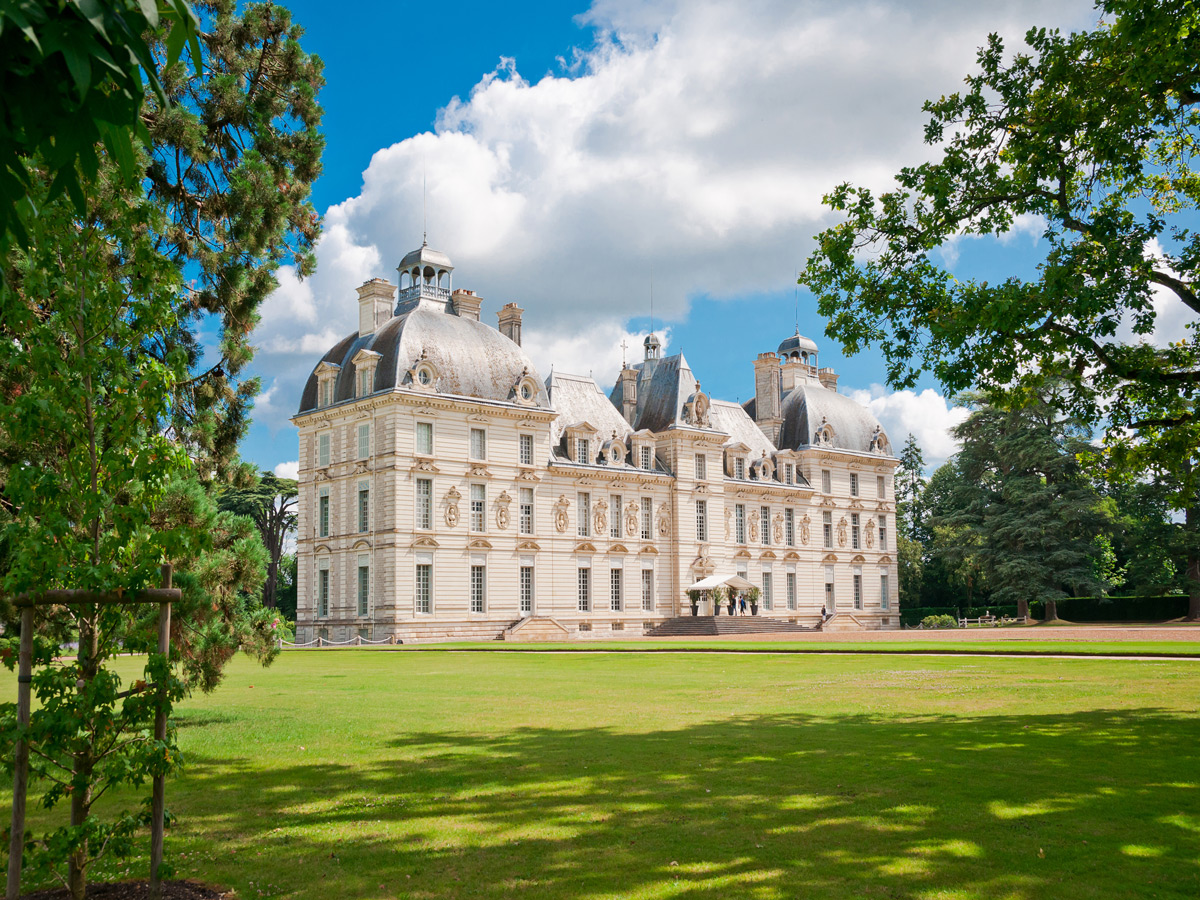
How can one fail to notice the resemblance between Cheverny Castle and Moulinsart, which enchanted the childhoods of all Tintin enthusiasts? Indeed, one need only remove the two wings at the ends of the castle to obtain a faithful copy of Captain Haddock’s residence, which first appeared in ‘The Secret of the Unicorn’. Thank you, Hergé!
Beyond this endearing nod, the castle is built from Bourré stone, from the eponymous village in the Cher Valley. Its particularity is that it hardens and whitens with age, explaining the whiteness of Cheverny’s facades.
The south facade is adorned with busts of Roman emperors sculpted ‘in the antique’ style, a practice fashionable since the Renaissance. The general plan of the castle is inspired by the Luxembourg Palace in Paris, but its corners topped with domes and its decorative stonework in superimposed lines mark an innovation that would become a characteristic of French classical architecture.
Discoveries at Cheverny Castle
Open to the public since 1922, many unique wonders await visitors within the castle. To name just a few:
- The staircase leading to the apartments is of classic style with a straight ascent (and not spiral as at Chambord and Blois), under a barrel vault, and adorned with rustic sculptures (garlands, fruits) combined with warrior symbols.
- The dining room, whose furniture in solid oak is carved with the Hurault arms, as is the Cordovan leather stretched over the upper part of the walls. The latter are also covered with 34 painted wooden panels (by Jean Mosnier) depicting the story of Don Quixote. The monumental fireplace topped with a portrait of Henri IV completes the majestic atmosphere of this unique room.
- The grand salon is no less impressive and features many portraits, of the Hurault family but not only: notably the presence of Anne of Austria, Gaston d’Orléans, Louis XIII or even Cosimo de’ Medici.
- The library contains more than 2,000 works, while the arms room, the largest room in the castle, displays an impressive collection of various weapons and armour in addition to the famous Gobelins tapestry. Visitors’ interest will also linger on the furniture of these two rooms, comprising Regency armchairs, a trunk belonging to Henri IV or a clock known as ‘the three mysteries’.
In each room, similar wonders are to be admired, each worth the visit alone. The French-style garden adorning the 100-hectare park should not be overlooked, especially as it frames a remarkable avenue facing the castle, six kilometres long!
An English-style garden, a vegetable garden, a trophy room containing nearly 2,000 deer antlers, a kennel housing around a hundred breed dogs, and an orangery further enrich the estate. You can explore it on foot or by boat of your choice, thanks to the watercourse that runs through it.
There is no doubt that your stay at Cheverny Castle will remain a joyful memory of your holidays. Both the interior and exterior are packed with points of interest, so do not hesitate to plan a full day to see everything. With a little luck, you may encounter the Marquis and Marquise de Vilbraye, whose apartments are still located in the right wing of the castle!
Also to discover, Chambord Castle: (re)live the Renaissance!