Château de Chambord: (re)experience the Renaissance!
Majestic. Imposing. Awe-inspiring. Superlatives are plentiful in the mouths of visitors discovering Chambord castle for the first time. Let us delve into the heart of the history of the largest of the Loire castles.
Majestic. Imposing. Awe-inspiring. Superlatives are plentiful in the mouths of visitors discovering Chambord castle for the first time. Or the second, for that matter, as a single visit will be insufficient to discover all its wonders. Before visiting for your next timeless journey, let us travel back several centuries to delve into the history of the largest of the Loire castles.
A symbol of royal power
It was in 1519 that François I ordered the construction of Chambord, on the site of a castle built by the counts of Blois in the 10th century. The King of France’s intention was to build a palace to his glory, following the military victory at Marignan. Chambord castle was initially conceived as a simple hunting pavilion, an annexe to Blois castle. François I would actually spend only 72 days there during his 32-year reign.
It was not until the reign of Louis XIV that the monarchy again took a real interest in the castle. The west wing, the chapel roof and the lower enclosure were then completed. Louis IX made nine stays at Chambord, sometimes accompanied by Molière’s troupe, who performed two comedy-ballets for him, including Le Bourgeois Gentilhomme in 1670.
The Revolution severely damaged the castle and its estate: pillaging and looting followed successive auctions of furniture and panelling. It subsequently became a private residence until its acquisition by the French state in 1930.
A Renaissance-era construction
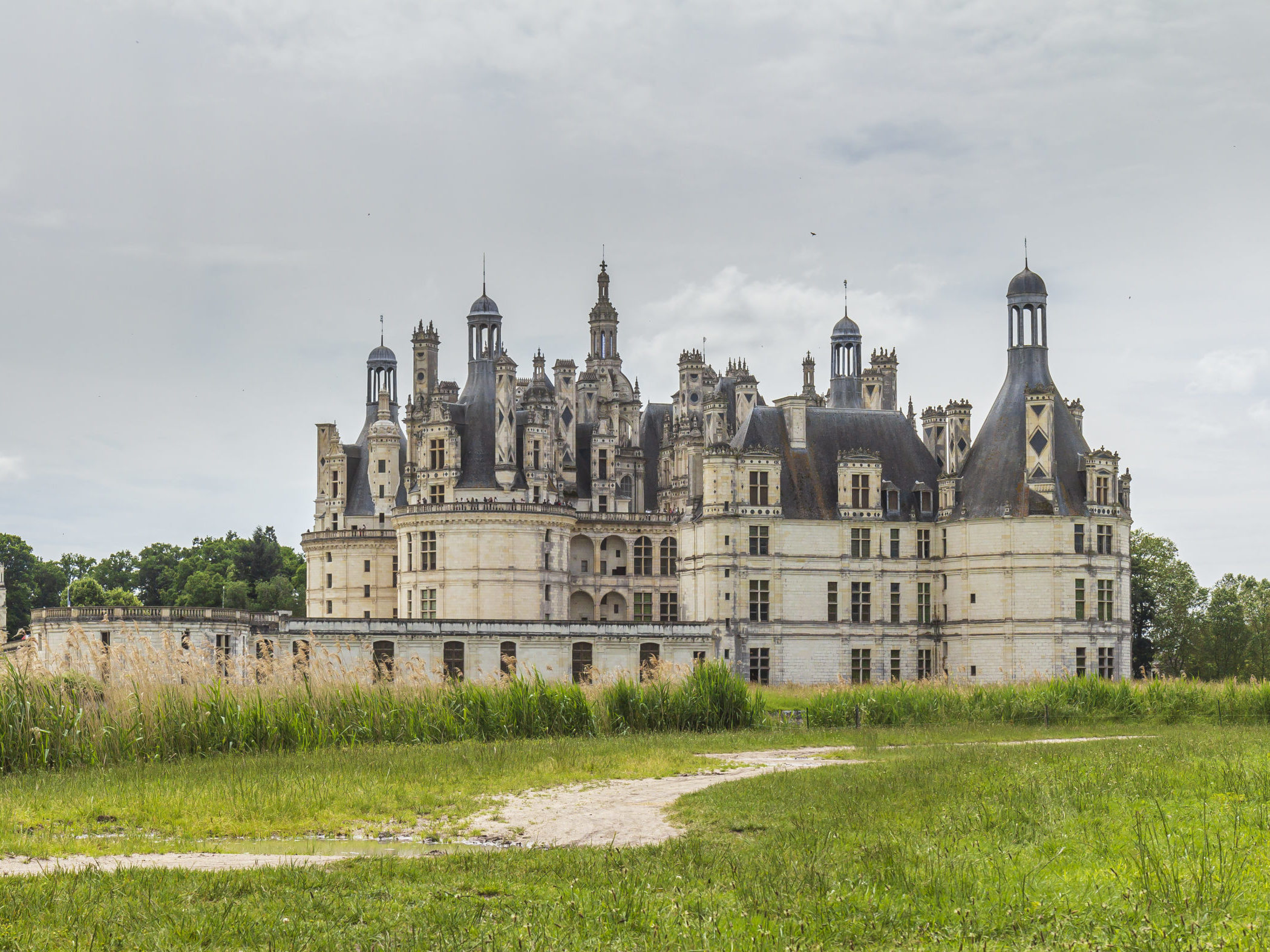
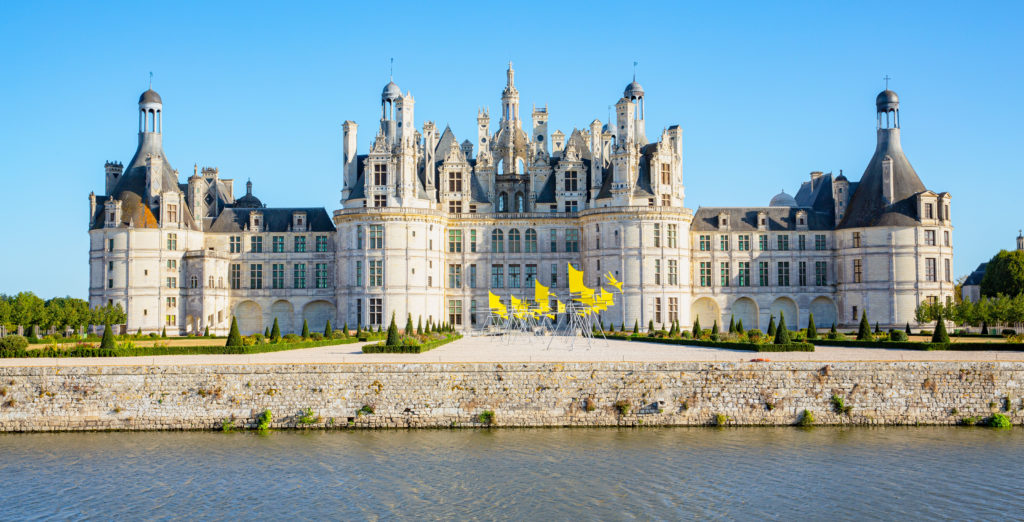
Located in Sologne, 14 kilometres east of the town of Blois and on a bend in the Cosson river, Chambord is unique. While inspired by the geometric principles of Renaissance architecture as defined by Alberti, its overall form – an enclosure with large corner towers – mimics medieval fortified castles. The building is primarily constructed from white tuffeau, a soft limestone whose porosity necessitates regular restoration works.
Historians believe that Leonardo da Vinci, who was based nearby at the time, contributed to its design. Whatever the case, the castle offers countless wonders: a 156-metre façade, 426 rooms and 77 staircases, 282 fireplaces and 800 sculpted capitals rising towards the sky, for a building measuring 56 metres in height. The keep offers five habitable levels, each comprising four square apartments and four others in the round towers.
Your stay today
Chambord is the only royal estate still intact. In its forest park of over 50 square kilometres surrounded by an enclosure wall 32 kilometres long, in autumn you may hear – or even observe – the powerful bellow of the stag. From permaculture kitchen gardens to the vineyard, many treasures await you on the exterior.
Inside, it is an indescribable array of ornaments. The Hunting Hall, the Hall of Illustrious Figures or the Huntsmen’s Hall offer different styles worthy of the finest Renaissance achievements. Not forgetting the famous Trophies Gallery whose light honours the domain around the castle.
The Carriage Hall will allow you to admire horse-drawn carriages made in 1871 for the Count of Chambord but never used. Their saddlery is the work of the House of Hermès. The King’s Lodging, the Queen’s Apartment and the State Apartment are also worth mentioning, riches within a castle that never ceases to amaze us.
If the opportunity arises, do not hesitate for a second to cross the enclosure of Chambord castle. Its fairy-tale atmosphere, unique in its kind, is felt from arrival. The leap in time is intense and the immersion total: all that remains is for you to dream of being a castle lord!