Zoom on 'Impression, Sunrise', Claude Monet's Most Famous Painting
'Impression, Sunrise' is undoubtedly Claude Monet's best-known painting but also that of the Impressionist movement. Presentation of an exceptional work that marked a turning point in Art History
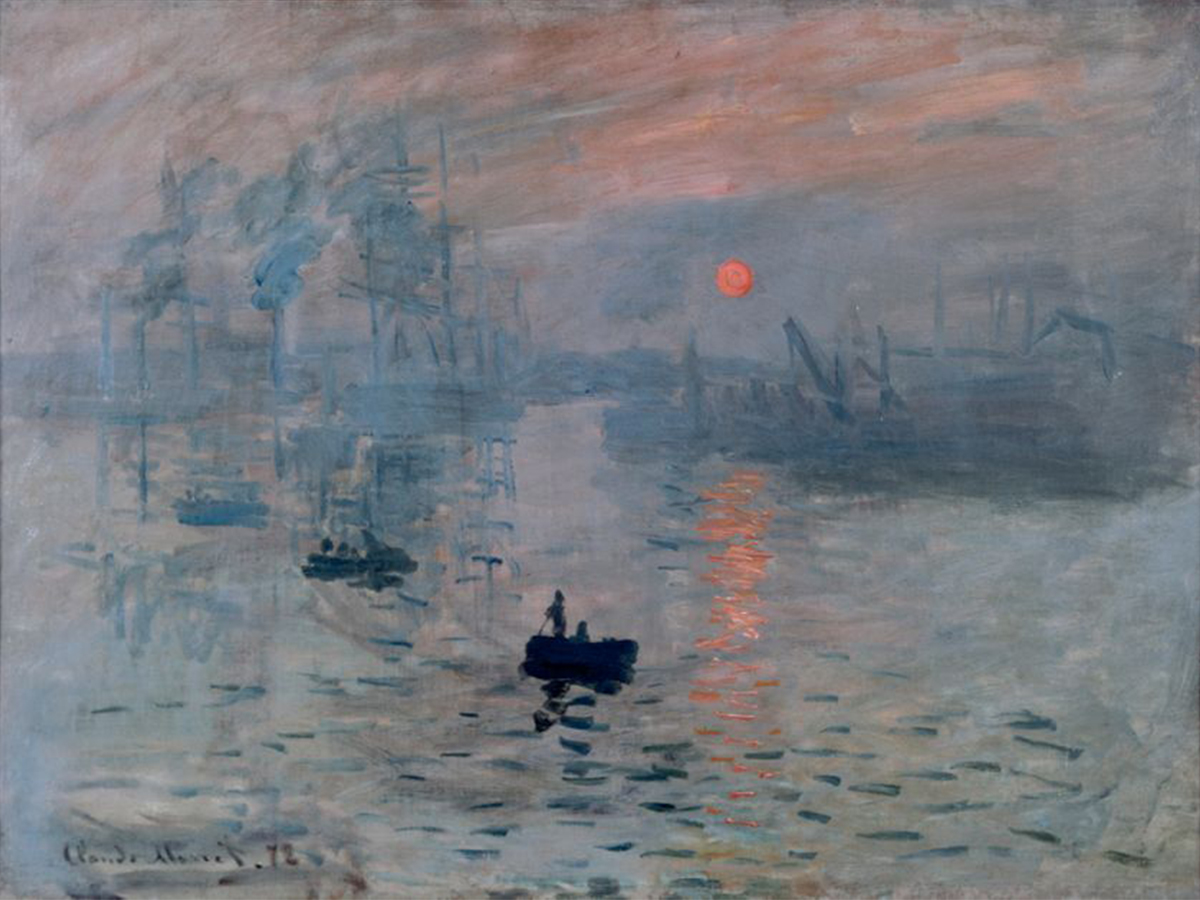
“Impression, Sunrise” is undoubtedly Claude Monet’s best-known painting but also that of the Impressionist movement. And for good reason: it is this work that gave its name to this period. A question then arises: why has this painting become so popular? Presentation of an exceptional work that marked a turning point in Art History.
The History of the Painting “Impression, Sunrise”
It was on 13 November that Claude Monet went to the port of Havre, the city where he grew up. The Industrial Revolution was shaping this period as society underwent a transformation. The port of Havre as we know it today is nothing like it was then: the bombings of the Second World War hadn’t taken place…
Claude Monet then painted this view probably having in mind the paintings of William Turner that he had been able to admire the previous year in London. His style is heavily marked by the atmospheric depth of the English painter, which, as we know, deeply moved him. It was painted in 1872, but according to some experts, it may have been made in 1873 or 1874.
A First Reveal That Was Heavily Criticised
Presented for the first time at the exhibition of the “anonymous society of artists, painters and engravers” in 1874, Monet’s work was the subject of much criticism. Just like the other works by the artists present, such as Renoir, Pissarro or Sisley. But if this painting is at the very origin of the term “Impressionism”, it is notably thanks to Louis Leroy who wrote in 1874 for Le Charivari, a mocking article about the exhibition. Leroy who spotted Monet’s canvas, wrote about it: “What does this canvas represent? Impression! Impression I was sure of it. I was saying to myself also since I am impressed, there must be impression in it. […] A wallpaper is more worked than this seascape”. He even titled his article “The Exhibition of the Impressionists”. Louis Leroy had just given a name to this new movement: “Impressionism”.
In other reviews, one could also read about this exhibition: “This ridiculous collection of absurdities”, “The most absurd daubs” or again “Messrs Monet and Pissarro and Miss Morisot seem to have declared war on beauty”.
Zoom on the Painting
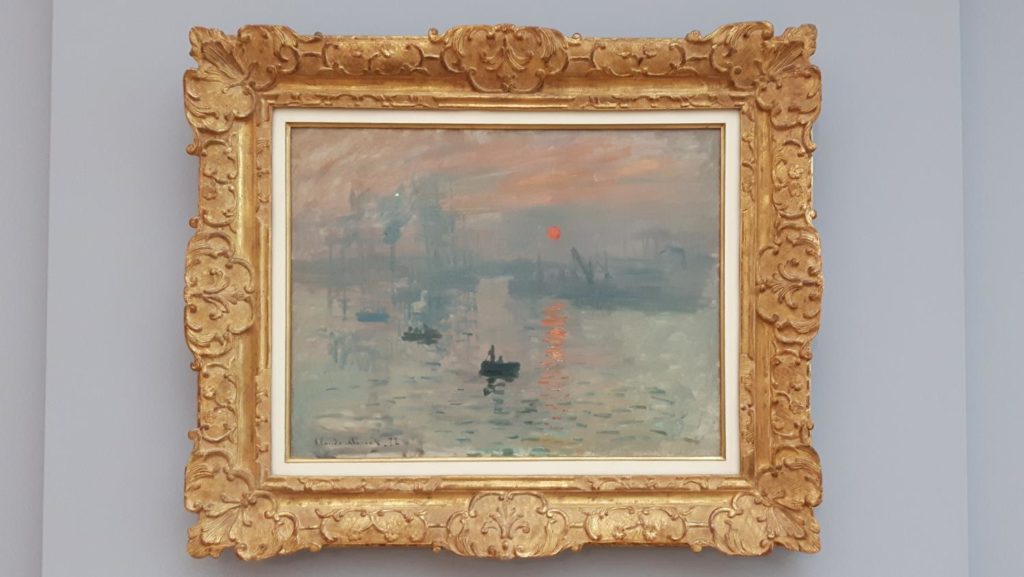
In the painting “Impression, Sunrise”, one can make out in the foreground the silhouette of a boat occupied by two fishermen. A little further away, a second boat reinforces the depth effect. The painting is in rather cold tones, with the exception of the sun breaking through the fog. It is undoubtedly the central point of the composition. Indeed, the sun stands out perfectly with its warm tones and sharpness, unlike the background, where the port of Havre is outlined with its sailing ships, steamboats and factories.
Through his painting, Claude Monet shows us a port in activity in the early morning. A scene very representative of the endless development of maritime trade during the mid-19th century.
Regarding its size, the work is rather small: 48 centimetres in height and 63 centimetres in width.
Bought back by Ernest Hoschédé, a friend of Monet, for 800 francs, it was subsequently resold to Georges de Bellio, a collector, for 210 francs. The painting remained in the family until 1938, when it joined the Marmottan Museum in Paris.
The “Impressionism” History
Impressionism is the fruit of numerous research and discussions. This movement was born in France during the latter part of the 19th century. Contrasting with the dark and obscure canvases of academic paintings, the Impressionists revolutionised the painting of this era. Techniques change, light, atmosphere and the eye of the painter become the true subject of the painting. Note that it still took almost 30 years for the eyes of contemporaries to get used to this new style of painting.
Would you like to know more about Impressionism? Here are 5 things to know about this movement.
The Marmottan Monet Museum, a Key Site of Impressionism
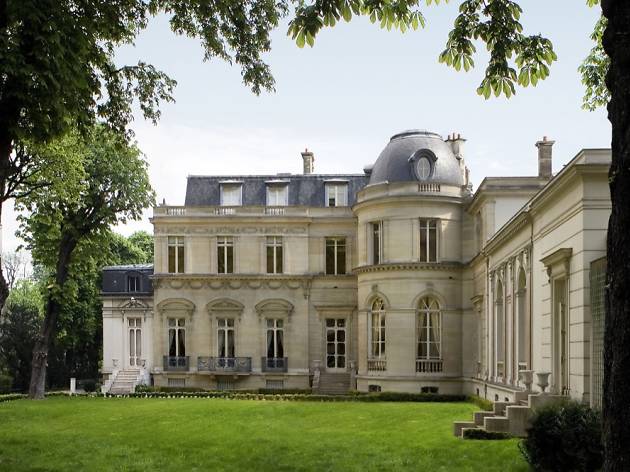
The Marmottan Museum, which became the Marmottan Monet Museum in 1990, is located in the 16th arrondissement of Paris.
This former townhouse was originally a hunting pavilion built for Marshal Christophe Edmond Kellerman, Duke of Valmy (1802-1868). It was bought in 1882 by Jules Marmottan, a lawyer, politician and art collector, who stored his collections devoted to the Napoleonic era there. His son Paul, also an art historian and collector, subsequently made it his home, which he bequeathed to the Academy of Fine Arts upon his death in 1934. The Marmottan Museum was born.
This place quickly transformed into a key site of Impressionism. The museum’s collection brings together more than 100 masterpieces by Claude Monet as well as numerous canvases by Gauguin, Guillaumin, Renoir, Sisley…
However, although it houses the greatest Impressionist works, the museum has other treasures. Indeed, it houses a collection combining paintings, furniture and art objects in the Empire style.
Also read: “Le Déjeuner sur l’herbe, a Work to Discover at the Musée d’Orsay”