Property purchase: how to plan for later life?
In terms of property purchase, as with all our choices, there is no accounting for taste. And that's a good thing! It allows atypical or even unusual properties to exist, sometimes luxurious and sometimes basic, of various shapes and made from various materials. However, there is one requirement that emerges over the years and which must be taken into account, at the risk of encountering difficulties in daily life: ensuring that you live in suitable accommodation when advanced age limits our physical or even relational capacities. A closer look at the good reflexes to adopt when such a purchase is being considered.

In terms of property purchase, as with all our choices, there is no accounting for taste. And that’s a good thing! It allows atypical or even unusual properties to exist, sometimes luxurious and sometimes basic, of various shapes and made from various materials. However, there is one requirement that emerges over the years and which must be taken into account, at the risk of encountering difficulties in daily life: ensuring that you live in suitable accommodation when advanced age limits our physical or even relational capacities. A closer look at the good reflexes to adopt when such a purchase is being considered.

Avoiding multi-storey properties
This is a matter of common sense that everyone can appreciate. Reaching an advanced age has as its first consequence an increasing difficulty in doing gymnastics. Climbing stairs can, at a certain point, become an insurmountable obstacle.
A person purchasing a property with a view to spending their later life there will therefore prefer a ground-floor property. The absence of floors and interior stairs is only part of the elements to consider: steps leading to the house or a somewhat steep exterior path can become equally disabling. It will be wise to opt for flat land, and a house built substantially at ground level.
Aiming for proximity to shops
As travel becomes less straightforward with age, it can then be beneficial to ensure you live not far from the most essential shops: bakery, pharmacy, butcher, caterer, etc. The most provident will settle near a hospital to facilitate the various medical examinations that are advised as age advances.
More generally, it is beneficial to avoid staying in an isolated property, especially if you are alone. Beyond security, it will become increasingly difficult to get around, and driving will even need to be banned from a certain age – or when loss of autonomy is observed.
A wise person therefore has every interest in acquiring a property in town or in the suburbs, trying to gather within a few hundred metres a maximum of places that correspond to their immediate or future needs.
Adapting the property to loss of autonomy
If possible, acquiring a property that is already easily accessible in all its components is beneficial. Failing that, it will be necessary to be able to envision possible adaptations when age makes certain daily gestures problematic.
So for example, the bath in the bathroom can be replaced by a shower, which is much easier to use for an elderly person. The stairs, if they cannot be avoided, can be fitted with a stairlift; budget between £3,000 and £9,000 depending on the size and complexity of the journey. The toilets can be raised and a grab bar can facilitate their use. Similarly, in empty spaces such as hallways or entrances, support bars fixed to the wall will help prevent falls.
Other parts of the house can simply be reorganised for greater practicality on a daily basis. In the kitchen specifically, the most used utensils should be stored within easy reach, and you should avoid having to reach for dishes in high cupboards as much as possible. In an extreme case, it is possible to motorise certain cupboards so that they present their contents at standing height.
Equipment must also be adapted, especially the hob for which induction should be preferred. Gas should obviously be banned from the moment a forgotten pan becomes a major risk.
Home automation as the culmination
New technologies make it possible to assist people, notably the elderly, in an increasing number of daily tasks. Home automation in this respect has undeniable advantages and will, for example, make it possible to open and close shutters, regulate heating temperature and manage the operation of various appliances using a single button, a single remote control, or even voice control.
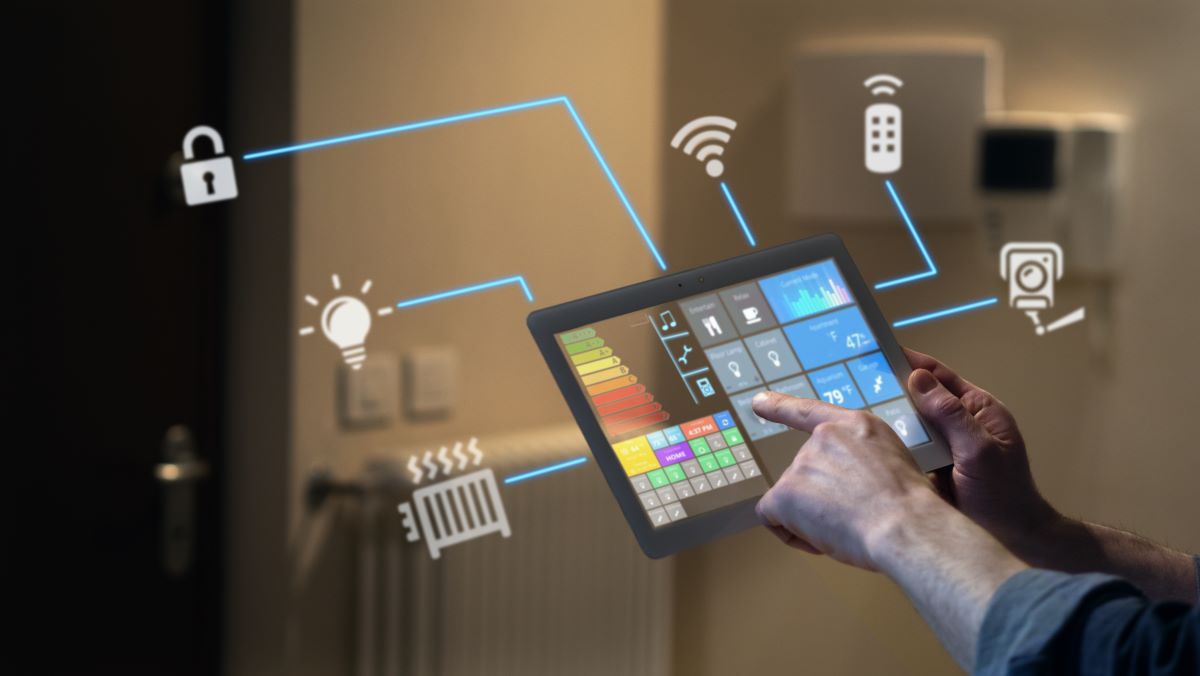
Security can also be greatly improved through home automation. Installing an alarm will help protect the property from intruders and today allows for extended protection: leaks of water, harmful gas or excessive humidity will be detected and the family can be warned automatically remotely. Installing a camera can also allow a relative to keep an eye on their parent’s living room to intervene more quickly in the event of a problem.
As technologies are set to develop, it is likely that in a few years’ time, robotics will even offer companion robots capable of imitating human presence and calling for help if necessary.
Co-living for security and sociability
A trend observed in recent years sees elderly people organising into shared accommodation between seniors. Ageing of the population indeed leaves an increasing number of people alone in their property, despite the risks linked to age. Community living, while it may disrupt well-embedded habits, then presents undeniable advantages, to break loneliness and watch over each other.
The gain is also financial, for people whose pension amount does not allow them to maintain, especially when they find themselves alone, a standard of living equivalent to what they previously knew. Sharing costs allows you to live more easily, and the practice proves beneficial in many cases.
Another co-living possibility increasingly frequently encountered is elderly people welcoming, into their house, much younger people, most often students. The exchange is beneficial for both parties: the student benefits from accommodation at a mini price, and brings dynamism and companionship to the elderly person, not forgetting the security that such a presence provides.
Preparing for later life involves first and foremost reflecting on the property that will be occupied and the needs that will arise. As the majority of elderly people wishing to remain in their homes for as long as possible, solutions exist to allow them to do so with more autonomy and greater security. As age makes it more complicated to undertake the process of taking out a mortgage, it is also useful to address the matter from your fifties. Even if they are not to be carried out at the time of acquisition, the initial budget must provide for the various adaptations useful for the future, which might be difficult to carry out once retired due to a drop in income. All that remains is to choose the lifestyle that suits you best!